NumbersCoach_Logo_Endorsed_UnderLogotype_2
  • Numbers Coaching
    • The Numbers Navigator®
    • Case Studies
  • About
    • Trillium-Numbers Coach Story
  • Resources
    • Blog
    • Numbers Coach TIPS
    • Podcasts
    • Numbers Coach Tools
  • Numbers Coach University
  • Contact
  • Search

The Art of Simplicity in Business: Why Less Leads to More

January 15, 2026 by Mike Iverson

In a world obsessed with innovation and expansion, simplicity often gets overlooked. Yet, simplicity is one of the most powerful drivers of profitable growth. When businesses complicate their operations, product lines, or customer experiences, they don’t just confuse their teams; they confuse their customers, slow down decision-making, and bleed money.

Complexity Kills Clarity

Many businesses fall into the trap of thinking more options equal more value. But offering too many choices can backfire. Research in behavioral economics shows that too many options can lead to decision fatigue and buyer paralysis. Customers who feel overwhelmed don’t choose; instead, they walk away.

Take the example of a tech company offering dozens of variations of the same product with slight differences in features or pricing. Instead of empowering the buyer, this complexity forces them to over-analyze and second-guess. Meanwhile, a competitor with a streamlined, easy-to-understand product suite often wins the sale.

The same goes for internal operations. When a company’s systems are bloated—layered with too many processes, tools, or departments—it becomes harder to adapt, harder to scale, and harder to focus on what matters: delivering value to the customer.

Simplicity Is Not Laziness—It’s Discipline

Simplicity requires ruthless prioritization. It means stripping away the nonessential and zeroing in on what works. Steve Jobs understood this when he cut Apple’s product line from dozens of models to just four when he returned as CEO in the late 1990s. That move helped save Apple from the brink of collapse and paved the way for one of the most profitable decades in its business history.

This isn’t about doing less for the sake of it—it’s about focusing effort where it counts. A simpler product line is easier to market, easier to sell, easier to support, and often more profitable. A leaner business operation responds faster to change, aligns better across teams, and burns less cash.

Simplicity Strengthens Execution

Complexity slows teams down. Decision-making becomes bogged down by approval chains, duplicated efforts, and unclear ownership. In contrast, a simple organization structure clarifies roles, speeds up execution, and improves accountability. That’s why some of the most efficient companies adopt clear frameworks and keep their operations tight, even as they grow.

Southwest Airlines is a classic example. While other airlines complicated their offerings with multiple aircraft types, seating classes, and ticket options, Southwest kept it simple: one type of plane, no frills, one fare structure. That simplicity allowed them to minimize training costs, streamline maintenance, and consistently turn profits in a volatile industry.

Customer Experience Demands Simplicity

Customers crave convenience. If your website takes too many steps to complete a purchase, if your pricing page reads like a tax form, or if your service menu is a maze, they’ll leave. Every extra step is a reason to drop off.

Companies like Amazon and Uber succeeded not because they invented something new, but because they made something old ridiculously easy. Amazon’s one-click checkout is simplicity in action. Uber took the friction out of calling a cab. The innovation wasn’t in the service, it was in removing the pain points.

Simplify to Scale

The true test of a business is not whether it can grow, but whether it can scale. Scale requires repeatable systems, clear offerings, and consistent delivery. Complexity chokes scale. It creates inconsistencies, bloated costs, and barriers to entry for new hires, partners, and even customers.

Simplicity is not the absence of detail; it’s the removal of waste. It’s focusing every ounce of energy on what drives results. That’s not just smart. It’s essential.

In Summary

The art of simplicity in business is not just a nice-to-have; these days it’s a competitive edge. Complexity wastes time, drains money, and stalls growth. Simplicity sharpens focus, accelerates execution, and boosts profitability. Businesses that master simplicity will scale, thrive, and dominate.

As Leonardo da Vinci said, “Simplicity is the ultimate sophistication.”

Let us know how we can help you simplify the numbers that drive your business growth.

Filed Under: Business Growth, Leadership, Numbers Coaching Tagged With: business growth, leadership tips, pricing strategies, profitability

Net Profit vs. Net Cash Flow: Key Differences Explained

November 12, 2025 by Mike Iverson

Net Profit vs. Net Cash Flow: Key Differences Explained

Understanding the difference between net profit and net cash flow is essential for accurately assessing a business’s financial health. While both metrics provide valuable insights, they serve distinct purposes and are calculated differently. Here’s an in-depth look at each concept and how they compare.


What is Net Profit?

Net profit, also known as net income, reflects the profitability of a business after all expenses have been deducted from its total revenue. It is a key indicator of financial performance and is reported on the income statement.

Formula for Net Profit

Net Profit= Total Revenue − (Operating Expenses + Taxes + Interest)

Net profit shows whether the business is operating efficiently and generating more income than it spends. A positive net profit indicates profitability, while a negative value (net loss) signals financial struggles.

Example of Net Profit

If a company earns $1,000,000 in revenue and incurs $700,000 in expenses (including operating costs, taxes, and interest), its net profit is:

$1,000,000 − $700,000 = $300,000

This means the company retains $300,000 as profit.


What is Net Cash Flow?

Net cash flow measures the cash movement in and out of a business during a specific period. It accounts for all operating, investing, and financing activities and is reported on the cash flow statement. Net cash flow is vital for understanding liquidity and a company’s ability to meet short-term obligations.

Formula for Net Cash Flow

Net Cash Flow = Cash Inflows − Cash Outflows

Net cash flow focuses solely on actual cash transactions, excluding non-cash items like depreciation or accrued expenses.

Example of Net Cash Flow

Suppose a company receives $800,000 from sales and spends $500,000 on expenses, loan repayments, and investments in the same period. Its net cash flow is:

$800,000 − $500,000 = $300,000

This indicates the business has $300,000 in cash available after covering its costs.


Key Differences Between Net Profit and Net Cash Flow

  1. Focus
    • Net Profit: Focuses on profitability, including non-cash expenses (e.g., depreciation).
    • Net Cash Flow: Focuses on liquidity, tracking actual cash movements.
  2. Accounting Basis
    • Net Profit: Calculated using accrual accounting, which recognizes revenue and expenses when incurred, not when cash changes hands.
    • Net Cash Flow: Based on cash accounting, reflecting real-time cash transactions flowing in and flowing out.
  3. Components
    • Net Profit: Includes revenues, operating expenses, interest, and taxes.
    • Net Cash Flow: Includes cash from operations, investments, and financing activities.
  4. Reporting
    • Net Profit: Reported on the income statement.
    • Net Cash Flow: Reported on the cash flow statement.

How They Interrelate

Net profit and net cash flow are interconnected but distinct. For example, a business can have a high net profit but struggle with cash flow if it has significant receivables, capital investment needs or inventory cycle disruptions. Similarly, strong cash flow doesn’t guarantee profitability if the company incurs high non-cash expenses or mismanagement of its working capital, which is inventory, accounts receivable, and accounts payable.

Scenario

A company earns a net profit of $200,000 but has a negative net cash flow of $50,000 due to heavy upfront investments or delayed payments from customers. In this case, the company appears profitable but may face liquidity issues.


Why Both Metrics Matter

  • Net Profit: Helps stakeholders assess long-term profitability and operational success.
  • Net Cash Flow: Ensures the business can manage day-to-day expenses and remain solvent.

Together, these metrics provide a comprehensive view of financial performance and stability, allowing businesses to make informed decisions.


Conclusion

Net profit and net cash flow serve different but complementary roles in financial analysis. While net profit highlights profitability, net cash flow emphasizes liquidity and operational efficiency. Understanding both metrics helps businesses maintain financial health, plan effectively, and ensure sustainable growth.

Need help in determining Net Cash Flow for your business? Check out our Cash Flow Tool Kit!

Filed Under: Blog, Cash Flow Planning, Financial Metrics, Financial Tools, Own Your Numbers

10 Tips For 2026 Tax Planning

October 13, 2025 by Mike Iverson

It’s that time of year: The time when businesses and individuals wind up the current year and begin to plan for the new year.

Part of the yearly business planning process should include tax planning, since the reality is that paying taxes will always be a part of your business. Or as the saying goes, “Nothing is certain but death and taxes.” (We will just stick with taxes here!)

Below are 10 ideas for tax planning that might be beneficial, depending on your circumstances. We update or add items based on recent legislation.  (Of course, always check with your tax accountant, as they are the expert when it comes to tax advice.)

10 Tips for 2026 Tax Planning

  1. Accelerate/defer income or deductions. At times, you can control the timing of income or expense payment. Shifting income or expenses can be beneficial to help lower your tax burden.
  2. Harvest capital losses for individuals.  Capital losses can be offset against capital gains.  Do this where it makes sense.
  3. State income tax. Consider the Pass-Through Entity Tax Deduction if you are a pass-through entity like an S-Corp or Partnership. An entity level state income tax can be federally deducted at the entity level and bypass the $40,000 SALT deduction limitation.
  4. Take advantage of tax credits to lower state income tax.  These credits can be used for job creation, research and development, and training.
  5. Charitable donations timing.  Determine what timing makes the most sense depending on the income/profits you expect to generate for the year. There are limitations on these deductions and your tax advisor can best figure out what works for you. Non-itemizers can claim deductions up to $1,000 for singles and $2,000 for married couples. Here at the Numbers Coach, giving back to our community is one of our cornerstone business goals.
  6. Make your estimated tax payments.  Make sure you are paying your estimated taxes if you earn income outside of your salary or if you are a business owner with pass-through income from your company.  An S-Corp or LLC will have pass-through income to its shareholders.  Failure to pay estimated quarterly taxes can result in penalties and interest.
  7. Carefully select your accounting methods.  This is often overlooked at the start of a company or even as it is in operation.  Determine whether cash or accrual basis accounting is best for your business model.  It’s not always obvious and your tax advisor can make sure it’s the most beneficial for your circumstances.
  8. Section 179 Expensing Deduction & Bonus Depreciation. A business can write off 100% of the cost of equipment (land and buildings are excluded).
  9. Qualified Business Income Deduction (QBI). For flow-through entities (partnerships, limited liability companies, S-Corps) there is a 20% of income deduction with certain limitations.
  10. Contribution to Retirement Plans. You can take a tax deduction of the lesser of $70,000 or 25% of an employee’s compensation for contributions to a 401(k), SEP IRA, or KEOGH.

Just a few tips to think about as you close out this year and plan for 2026.  Let us know if we can help with your financial planning, or check out our Financial Planning Tool Kit.

Here’s to a healthy 2025 year-end and a profitable 2026!
Mike

Filed Under: Business Planning, Cash Flow Planning, Money Tips, Numbers Coach TIPS, Tax Planning Tagged With: business taxes, tax planning, year-end tax planning

Mastering the Art of Cash Outflow Forecasting in Your Business

September 23, 2025 by Mike Iverson

Cash flow is the lifeblood of any business, and managing it effectively is crucial for your overall success. One of the key aspects of cash flow management is forecasting cash outflows. By accurately predicting where your money will be going, you can make informed decisions, avoid financial surprises, and ensure that your business remains financially healthy.

10 Tips for Cash Outflow Forecasting

Here are 10 essential steps to help you forecast cash outflows in your business:

  1. Gather Historical Data: Start by examining your past financial records. Analyze your previous cash outflows to identify trends and patterns. This historical data will serve as a valuable reference point for making future forecasts.
  2. Categorize Expenses: Divide your expenses into fixed and variable categories. Fixed expenses, like rent or loan payments, remain consistent. Variable expenses, such as utilities or raw materials, can fluctuate based on your business activities.
  3. Identify Timing: Take note of when your expenses are due. Some payments may be monthly, while others could be quarterly or annually. This timing is critical for a precise cash flow forecast.
  4. Project Future Expenses: Use your historical data and business plans to estimate future cash outflows. Be thorough and account for all potential expenses, even those that occur irregularly.
  5. Prioritize Payments: Determine the priority of each payment. Essential expenses that are directly tied to your core operations, like salaries or rent, should be paid first. This ensures that your business continues to run smoothly.
  6. Consider Seasonal Fluctuations: If your business experiences seasonal variations, account for this in your forecast. Some months may require higher cash reserves to cover increased expenses.
  7. Risk Assessment: Be mindful of potential risks and uncertainties that could impact your cash flow, such as economic downturns or unexpected expenses. Having a contingency plan is essential.
  8. Use Technology: Leveraging accounting software and financial forecasting tools can streamline the process and enhance accuracy. These tools, such as our Cash Flow Tool Kit, can help you create detailed financial projections and scenarios.
  9. Regularly Update Your Forecast: Your cash flow forecast should be a dynamic document. Update it regularly with actual results.
  10. Monitor and Adjust: Keep a close eye on your actual cash flow compared to your forecast. If deviations occur, adjust your strategies accordingly. This ongoing monitoring helps you stay on top of your financial health.

Forecasting cash outflows is a fundamental aspect of financial management for any business. By understanding your past financial data, planning for future expenses, and adapting to changing circumstances, you can ensure that your business remains financially resilient and capable of weathering a financial storm. A well-executed cash outflow forecast is an invaluable tool that empowers you to make informed decisions and secure the financial stability of your business.

Be sure to check out our Cash Flow Tool Kit, which includes helpful templates to build your forecast.

Filed Under: Cash Flow Forecasting, Cash Flow Planning, Financial Tools Tagged With: financial metrics

Option 1 Partners Builds Financial Road Map With Help From the Numbers Coach

June 17, 2025 by Mike Iverson

The Company

Option 1 Partners (“O1P”) is a consulting advisory firm started and nurtured by Jackie Flake and Ren Waldron.  O1P provides a full range of consulting services, including recruiting and talent acquisition, Agile transformation services, product strategy, product management, staff augmentation, and coaching. The company specializes in assessing your needs, matching it with teams to meet your vision, and help you build products and analysis for their client’s to successfully scale.  O1P has been providing its high-quality services for over 10 years. 

Situation

In 2025 the O1P team wanted to enhance their understanding of their financial results.  They wanted to use a platform to communicate the company’s key performance indicators (“KPIs”) and educate the leadership team members on what drives the company’s financial results.  The O1P team was missing a financial “road map” that could guide them to make better financial decisions for the company.

Solution: The Numbers Coach Leadership and Numbers NavigatorTM Services

The Numbers Coach (“NC”) financial leadership services were an ideal fit for O1P.  Using NC’s proprietary Numbers NavigatorTM platform, a financial scorecard is created to focus on measurements that drive company’s profits and cash flow critical to sustaining a business.  The scorecard offers the O1P team “at a glance” view of results.  In addition, the Number Navigator’sTM rolling financial forecast gives the O1P team a tool to make critical decisions and see their financial road ahead. 

Mike’s approach to coaching us on how to understand our financial results gives our team the tools to help us navigate our finances successfully and stay focused on our cash flow and investment goals.

~Jackie Flake & Ren Waldron, Co-Founders of Option 1 Partners

Results

NC pulled together financial and non-financial data to complete a scorecard, financial model, and supplemental reporting.  Each quarter the O1P team meets with the Numbers Coach to methodically review results and provide input and analysis from the Numbers NavigatorTM.  After each Numbers Coach meeting, the O1P team can act on activities that improve the company’s bottom line.  Jackie, Ren, and their team can access the Numbers NavigatorTM at any time with its cloud-based delivery platform.

For more information on Option 1 Partners visit www.option1partners.com

To learn more about the Numbers Coach financial leadership services, click here

Filed Under: Case Study, Financial Modeling, Financial Tools, Key Performance Indicators, Leadership, Numbers Coaching Tagged With: business financial planning, financial management, financial metrics

Money Tips From the “Oracle of Omaha”

May 5, 2025 by Mike Iverson

We all know Warren Buffett, founder and CEO of Berkshire Hathaway, is famous for his investing skills. He’s the guy who, at age seven, as the story goes, borrowed a book titled, “One Thousand Ways to Make $1000,” from a public library in his hometown of Omaha, Nebraska. One thousand quickly became many thousands, then millions, and billions.

Now at age 92, Buffett has a net worth of over $90 billion and ranks number six on the Forbes’ 2025 World’s Billionaire List. He still lives in Omaha, and is known as “the Oracle of Omaha,” a down-to-earth guy with memorable and profitable financial tips.

Here are 5 of his best money tips:

  1. Take smart risks. Instead of buying any stock that has gone down in price, buy it only if you believe in the company. Is it a company that has a solid foundation and can handle an unpredictable economy and come back strong? According to Buffett, “risk comes from not knowing what you’re doing.” He says the best way to minimize risk–something he highly recommends doing–is to actively educate yourself about finances. “Invest in as much of yourself as you can, you are by far your biggest asset,” he notes.
  2. Develop positive money habits. Buffett also encourages people to develop positive money habits, no matter what their age or stage of life. Habits such as saving money for a rainy day, and not going into debt. In a 2007 address at the University of Florida, Buffett explained that most behavior is habitual and the “chains of habit are too light to be felt until they are too heavy to be broken.”
  3. Become debt adverse. Then there are Buffett’s popular financial rules, “Rule 1: never lose money. Rule 2: never forget rule 1.” The point is that it’s hard to bounce back when you are working from a loss. The Oracle of Omaha is debt adverse. He says he would rather make interest work for him than work to pay interest. “If you are smart, you are going to make a lot of money without borrowing.”
  4. Cash is King. Buffett is unwavering in his advice to keep a good stash of cash in business and personal life. It may be tempting to invest all your cash or spend a lot on something because it’s a good deal and a “once in a lifetime opportunity,” but resist the temptation. Not having cash reserves may be your downfall. You never know when you will need it.
  5. View money as a long-term game. Buffett once said, “Someone is sitting in the shade today because someone planted a tree a long time ago.” Building wealth, paying off debt, making a profit, saving for college and retirement take time and patience. Remain steady and keep your eyes focused on the end game of financial security.

Filed Under: Blog, Money Tips, Own Your Numbers Tagged With: financial education, financial leadership

Is Your Customer Creditworthy? 7 Key Metrics to Find Out

March 17, 2025 by Mike Iverson

When taking on a new client, your business is also taking on risk. What if your client doesn’t pay their bills? To minimize risk and ensure timely payments, it’s important to evaluate the creditworthiness of any business customer.

At the Numbers Coach, we recommend using these 7 key metrics to evaluate your customer and assess your business’s potential risk:

  1. Credit Score and History: A strong credit score and positive credit history indicate a reliable payment track record. Review their business credit report for any defaults, late payments, or bankruptcies. For a business, this is typically found through Dun & Bradstreet ratings or other business rating agencies such as Moody’s.
  2. Liquidity Ratios: Metrics like the current ratio (Current Assets / Current Liabilities) and quick ratio ((Current Assets−Inventory) / Current Liabilities) assess the customer’s ability to meet short-term obligations. Ratios above “1” generally indicate good liquidity.
  3. Debt-to-Equity Ratio (D/E): This ratio measures the level of financial leverage, calculated as Total Liabilities / Shareholders’ Equity. Lower ratios suggest the customer isn’t overly reliant on debt, reducing credit risk.
  4. Payment History: Review their payment behavior with other suppliers. Consistent on-time payments signal financial reliability.
  5. Financial Statements: If possible, get a set of financial statements for the past three years: ideally, a Balance Sheet, Income Statement, and Cash Flow Statement. Analyzing these statements will help you evaluate their ability to pay.
  6. References and Trade Insights: Obtain references from other vendors and industry insights to gauge the customer’s reputation and stability.
  7. Z-Score: If you can get financial information from your customer, then running it through a Z-Score calculation can be a helpful measure to ensure they are financially viable.

Using these metrics, you can make informed decisions and reduce your company’s exposure to bad debt.

Questions on any of these calculations? Feel free to ask the Numbers Coach.

Filed Under: Financial Metrics, Financial Tools, Numbers Coach TIPS, Own Your Numbers Tagged With: cash flow statement, credit risk, creditworthiness, financial management, financial metrics

Z-Score: What is it and how can it protect your business?

March 17, 2025 by Mike Iverson

The Altman Z-Score is a financial metric used to predict the likelihood of a business going bankrupt within the next two years. Developed by Edward Altman in 1968, it combines various financial ratios into a single score to assess a company’s financial health.


Formula for Altman Z-Score

The formula varies for different types of companies (public, private, manufacturing, or non-manufacturing). For publicly traded manufacturing firms, it is:

Z=1.2X1+1.4X2+3.3X3+0.6X4+1.0X5

Where:

  • X1​: Working Capital / Total Assets
  • X2: Retained Earnings / Total Assets
  • X3​: EBIT / Total Assets
  • X4: Market Value of Equity / Total Liabilities
  • X5​: Sales / Total Assets

Interpreting the Score

  • Z > 2.99: Low risk of bankruptcy (safe zone)
  • 1.81 < Z < 2.99: Moderate risk (gray zone)
  • Z < 1.81: High risk of bankruptcy (distress zone)

Uses in Business

  1. Risk Assessment: Investors and creditors use the Z-score to evaluate the financial stability of companies and assess credit risk.
  2. Decision-Making: Businesses use it for self-assessment, identifying financial weaknesses to improve operational efficiency and solvency.
  3. Comparative Analysis: The score helps compare financial health across firms, industries, or over time.
  4. Mergers & Acquisitions: Acquirers use the Z-score to assess the viability of target companies.

Limitations

  • It is less accurate for non-manufacturing or newer businesses.
  • Market value dependence can make it volatile in fluctuating markets.

Despite these limitations, the Altman Z-score remains a powerful tool for proactive financial management and decision-making.  It can be one of the tools in your “tool set” to analyze customers’ credit worthiness, target businesses to acquire, or understand your own company’s financial stability.


Understanding the Altman Z-Score for Business The Altman Z-Score is a financial metric used to predict the
likelihood of a business going bankrupt within the next two years. Developed by
Edward Altman in 1968, it combines various financial ratios into a single score
to assess a company’s financial health.


Formula for Altman Z-Score The formula varies for different types of companies (public,
private, manufacturing, or non-manufacturing). For publicly traded
manufacturing firms, it is: Z=1.2X1+1.4X2+3.3X3+0.6X4+1.0X5 Where:
  • X1​: Working Capital /
    Total AssetsX2:
    Retained Earnings / Total AssetsX3​: EBIT / Total AssetsX4:
    Market Value of Equity / Total LiabilitiesX5​: Sales / Total Assets


  • Interpreting the Score
  • Z
    > 2.99
    : Low risk of bankruptcy (safe zone)1.81
    < Z < 2.99
    : Moderate risk (gray zone)Z
    < 1.81
    : High risk of bankruptcy (distress zone)


  • Uses in Business 
  • Risk
    Assessment
    : Investors and creditors use the Z-score to evaluate the
    financial stability of companies and assess credit risk.Decision-Making:
    Businesses use it for self-assessment, identifying financial weaknesses to
    improve operational efficiency and solvency.Comparative
    Analysis
    : The score helps compare financial health across firms,
    industries, or over time.Mergers
    & Acquisitions
    : Acquirers use the Z-score to assess the viability
    of target companies.


  • Limitations 
  • It is
    less accurate for non-manufacturing or newer businesses.Market
    value dependence can make it volatile in fluctuating markets.
  •  Despite these limitations, the Altman Z-score remains a
    powerful tool for proactive financial management and decision-making.  It can be one of the tools in your “tool set”
    to analyze customers credit worthiness, targeting businesses to acquire, or
    understanding your own company’s financial stability.

    Filed Under: Financial Metrics, Financial Tools Tagged With: financial metrics

    Thermal Support Finds Financial Support with the Numbers Coach

    February 20, 2025 by Mike Iverson

    The Company

    Thermal Support (“TS”) is an international source for thermal analysis consumable products started and nurtured by Charles Beine.  TS provides a full range of thermal analysis DSC sample pans and TGA and TG/DTA sample pans. The company’s high-quality aluminum and ceramic pans are the standard as a non-OEM supplier.  TS serves a wide geographic area nationally and internationally, including labs and university research centers.  TS has been providing its high-quality products and support services for over 20 years. 

    Situation

    In 2024 the TS team wanted to enhance their understanding of their financial results.  They wanted to use a platform that communicated the company’s key performance indicators (“KPIs”) and educate its leadership team members on what drives the company’s financial results.  The TS team was missing a game plan that could guide them to make better financial decisions. Enter Numbers Coach Mike Iverson.

    Solution: The Numbers Coach Financial Leadership Services

    The Numbers Coach (“NC”) financial leadership services were an ideal fit for TS.  Using NC’s proprietary Numbers NavigatorTM financial platform, a financial scorecard is used to focus on measurements that drive company profits and cash flow critical to sustaining a business.  The scorecard offers the TS team an “at a glance” view of results.  The Number Navigator’sTM rolling financial forecast gives the TS team a tool to make critical decisions and see where they are headed financially. 

    Results

    NC pulled together financial and non-financial data to complete a scorecard, financial model, and supplemental reporting.  Each quarter NC meets with the TS team to methodically review results and provide input and analysis from the Numbers NavigatorTM.  From each Numbers Coach financial meeting, the TS team can take actions on activities that improve the company’s bottom line results.  Beine and his team can access the Numbers NavigatorTM at any time due to its cloud-based delivery platform.

    “Mike’s approach to coaching us on how to drive our financial results gives our team the right tools to help understand how to navigate our finances successfully and stay focused on our cash flow and investment goals.” 

    Charles Beine, Founder & CEO

    For more information on Thermal Support visit www.thermalsupport.com

    To learn more about the Numbers Coach financial leadership services, click here

    Filed Under: Case Study, Financial Modeling, Financial Reporting, Key Performance Indicators Tagged With: business financial planning, financial metrics, financial scorecard, key performance indicators

    Get Personal with Your Business Financial Planning

    February 7, 2025 by Mike Iverson

    As a business owner, aligning business financial planning with personal financial goals is essential for your long-term financial health. But how to go about it successfully?

    Here are 8 key strategies we recommend:

    1. Separate Finances: Maintain distinct accounts for personal and business finances. This ensures clear tracking of cash flow, expenses, and tax obligations, reducing financial complexity.
    2. Set Clear Goals: Define both personal and business financial objectives. For example, retirement savings, family expenses, and business expansion should align to support overall wealth-building strategies.
    3. Pay Yourself Strategically: Establish a salary or draw of consistent income that the business can support. Avoid withdrawing erratically because it disrupts cash flow and personal budgeting.
    4. Leverage Tax Strategies: Optimize tax planning for both personal and business finances. Utilize deductions, credits, and retirement contributions to reduce taxable income and maximize savings. However, don’t use strategies that may reduce your tax bill, but ultimately cause harm to your cash flow needs.
    5. Build Emergency Funds: Maintain separate emergency reserves for personal and business needs to address unexpected challenges without compromising either. How much to maintain? This is a personal question that relates to 1.) how much risk you are comfortable to take and 2.) how reliable and consistent your cash flow is from the business. You often hear 3-6 months of expenses as reasonable. In some situations, the Numbers Coach recommends over 12 months, due to the unreliability of business cash flow. (See this recent post for more guidance.)
    6. Plan for Retirement: Use tax-advantaged retirement accounts like SEP IRAs or solo 401(k)s. These account allow higher contributions for self-employed individuals, linking personal retirement savings with business success.
    7. Manage Debt Wisely: Balance personal and business debt to avoid over-leveraging. The Numbers Coach philosophy is to minimize the use of debt. When it is used, then prioritize debt repayment while ensuring sufficient liquidity.
    8. Consult Professionals: Work with financial advisors and accountants experienced in both business and personal finance to create a cohesive plan tailored to your goals. But remember, you are the only one who truly cares about your money. As much as your advisors try to have your best interest at heart, it is up to you to learn and know your numbers.

    By integrating these aspects into your business and personal financial planning, you can build financial stability, meet personal aspirations, and position your business for long-term success.

    Filed Under: Blog, Financial Planning, Own Your Numbers, Tax Planning Tagged With: business financial planning, cash flow, debt management, personal financial planning, retirement planning, tax planning

    Cash Reserve: How Much Is Enough?

    January 27, 2025 by Mike Iverson

    Here at the Numbers Coach, we have often discussed the importance of businesses establishing cash reserves (see this article for more details on how and why). Having a cash reserve gives a business owner a good chance of continuing operations even during very challenging economic times.

    The next step is determining how large of a reserve is needed. Clients often ask us how much cash they need to keep in reserve. However, the answer varies from one business to the next. Let me explain.

    Are You in a “Nice to Have” or a “Need to Have” Business?

    Scenario 1: Non-essential businesses

    Some businesses suffer cash flow problems during an economic downturn because their products and services are non-essential. For example, the purchase of golf clubs is easily postponed in the midst of recession. Golf shops, therefore, would be advised to have comparatively large cash reserves to get them through a rough patch. Being fairly conservative in our outlook, we might advise this type of client to build a cash reserve that would cover all business expenses for a period of six to nine months.

    A cash reserve of that size affords the business owner a significant amount of financial flexibility. Even in the worst recession, cash receipts don’t come to a screeching halt. Some percentage of customers will have a hard time paying their accounts on time, and sales will suffer a setback. A really bad month might see year-over-year cash receipts decrease by 50 percent. If an owner has nine months’ worth of expenses set aside in cash reserves, he could last through 18 really bad months just using cash reserves. That’s a nice cushion.

    Scenario 2: Businesses with choppy, unpredictable cash flows

    For example, consulting practices are notorious for having a very good month, in terms of cash receipts, followed by one or more cash-poor months. Whether it’s a good or bad month for cash receipts depends on what projects are in progress, the stage of completion for those projects and when progress payments fall due.

    A business like that needs a cash reserve that is large enough to carry it through the predictable condition of low cash receipts, as well as the possibility of economic distress exacerbating the problem. We might advise this type of client to hold nine to twelve months’ expenses in cash reserves.

    Scenario 3: Essential businesses

    At the other end of the spectrum are businesses that provide products or services that are essential and have rather predictable cash flows. An orthopedics practice is a good example. When a bone is broken, getting it treated promptly is an absolute necessity, no matter what’s going on with the economy. So, revenues of an orthopedics practice could be pretty strong. At the same time, the practice isn’t entirely immune to a struggling economy. Some patients will find it harder to pay their bills on time. A practice like this might need a cash reserve equal to three to six months’ business expenses.

    Think Defensively

    During a poor economy, a business owner has to manage liquidity by closely monitoring three sources of cash:

    1. bank accounts
    2. cash from outstanding accounts receivable
    3. available lines of credit

    Alternately tapping cash reserves and lines of credit further extends the time that the business can operate with a negative cash flow—i.e., business expenses exceed cash receipts.

    During a business contraction, banks may withdraw some of their outstanding commitments regarding lines of credit. For this reason, running through all of your cash reserves before tapping credit lines may not be advisable.

    What About Factoring?

    Finally, customers who are suffering a cash crunch sometimes ask about the possibility of selling part of their accounts receivable—a practice known as factoring. It is a way to accelerate cash receipts without having to dip into cash reserves or lines of credit.

    However, factoring can be quite costly depending on your arrangement with the factoring firm and how well your customers pay. The factor may charge you an upfront fee for the amount of receivables sold and include an escrow for a customer account not paid on time. Business owners need to make sure that the fees paid don’t deteriorate their business profits too much.

    If your business is suffering cash constraints, or if you foresee the possibility, seek the advice of a financial advisor for a thorough discussion of your options. Let us know how we can help.

    Filed Under: Blog, Cash Flow Forecasting, Cash Flow Planning, Financial Modeling, Financial Planning Tagged With: business financial planning, cash reserve

    Metric for Growth: Gross Profit Margin

    November 5, 2024 by Mike Iverson

    If a business owner had to manage by one single business metric, Gross Profit Margin (GPM) would be a solid choice.  It provides a good look at the important relationship between a business’s Sales and its Cost of Goods Sold. Understanding this relationship is critical to business success.

    The Calculation:
         Gross Profit Margin  =  (Net Sales – Cost of Goods Sold) / Net Sales


    (The calculation above uses numbers taken from an Income Statement. GPM is calculated as a ratio and is normally expressed as a percentage.)

    Why is GPM an important metric to follow?  Understanding your GPM is critical because it lets you as the owner know what it takes to be profitable after covering your other overhead costs that are not part of your Cost of Goods Sold in your GPM.

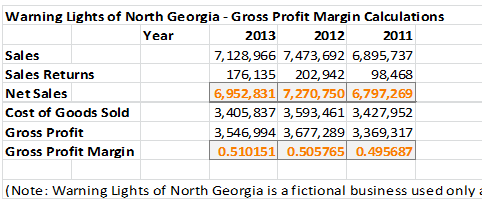
    Below is an example of a company that focused on improving its GPM from year to year. For 2011, its GPM was 49.6 percent. For 2013, the number increased to 51.0 percent. In just two years, the company improved GPM markedly. Had the company’s GPM remained static from 2011 to 2013 at 49.6 percent, Gross Profit for 2013 would have been lower by more than $102,000 lower.  

    Although incremental improvement to GPM can be difficult to achieve, when accomplished it is truly a gift that keeps on giving.  The $102,000 in higher profits (and cash flow) that Warning Lights of North Georgia achieved during the past two years should continue in future years.  Improving GPM might come from finding new and lower cost sources of raw materials or re-engineering processes—without harming product quality.

    Let’s do an example to illustrate the importance.  If your GPM percent is 40% and your overhead costs that you need to cover each month regardless of whether you sell anything is $100,000, then how much business do you need to generate just to breakeven for the month?

    If you don’t know the answer to this question, it could mean the difference between losing money or making money.  In our example above, it would require the business to generate $250,000 in revenue to cover its overhead costs.  How did we come to this conclusion?  Using the following formula:

    • $100,000 overhead cost / 40% = $250,000

    Keep a close eye on your GPM because it can make the difference between operating at a profit or at a loss.

    Here are some Numbers Coach tools to help you calculate your GPM:

    Tool kit

    “8 Essential Numbers” online course

    Filed Under: Blog, Business Growth, Financial Metrics, Financial Tools, Numbers Coach University Tagged With: financial leadership, financial metrics, gross profit margin, numbers coach

    • 1
    • 2
    • 3
    • …
    • 9
    • Next Page »
    NumbersCoach_Logo_green-gray_stacked

    Proud Supporter of

    Screenshot 2025-09-09 150120

    Get Financial Tips Delivered To Your Inbox

    Protect your business' financial health with our monthly financial tips.

    Contact Info

    P.O. BOX 250
    Decatur, GA 30031

    404-353-2148

    info@numberscoach.net

    © 2026 Trillium Financial, Inc
    Privacy Policy | Accessibility | Terms