
NumbersCoach_Logo_Endorsed_UnderLogotype_2
  • Numbers Coaching
    • The Numbers Navigator®
    • Case Studies
  • About
    • Trillium-Numbers Coach Story
  • Resources
    • Blog
    • Numbers Coach TIPS
    • Podcasts
    • Numbers Coach Tools
  • Numbers Coach University
  • Contact
  • Search

Numbers Coach Identifies Opportunities for Improved Cash Flow for Environmental Engineers

April 21, 2026 by greenmellen

THE COMPANY

In 1996, Scott Pate launched Sierra Piedmont (“SPI”) with a vision to create a superior environmental consulting, site assessment, compliance, and remediation services firm. Since then, SPI has served a wide range of companies from Fortune 100 businesses to regional firms throughout the United States. SPI’s innovative solutions and advice have helped its clients solve their environmental issues.

SITUATION

Pate and SPI’s management team wanted to realize improved cash flow in their day-to-day operations. However, they were not clear on which financial metrics were truly driving the business and needed more meaningful insights beyond the Profit & Loss statement.

SOLUTION: The Numbers Navigator™

SPI hired the Numbers Coach to provide a comprehensive analysis of its financial operations.The Numbers Coach (“NC”) uses its proprietary Numbers Navigator™ tool set to determine the key financial drivers in SPI’s business model. NC gained a further understanding of SPI’s key business issues through a discovery session with management. NC provided Pate and his team with a comprehensive financial report that identified opportunities to drive more cash flow from the business.

RESULTS

Together, NC and SPI determined realistic and actionable strategies to realize improved cash flow quickly. To achieve this goal, NC provided:

  • A 20+ page financial report detailing key drivers in SPI’s business model,
  • A systematic cash flow forecasting model to provide SPI visibility into its future cash flow,
  • “What if” scenarios analyzed to understand the impact of different financial strategies,
  • Establish guiding principles for disciplined cash flow management process
  • A short-term planning tool to ensure resources and cash were allocated appropriately

“Although it sounds cliché, Numbers Coach and the Numbers Navigator™ truly changed our financial life!” explains Pate.  “The fact is, for many years we had little or no ability to perform high level “what-ifs” or projections of cash effects based on pulling different levers in the company.”

“I don’t know of another program quite like this one,” says Pate. “It doesn’t seem boilerplate or ‘canned.’  I think the most benefit is received by using the Navigator in conjunction with Numbers Coaching services to understand how to apply what is revealed by the report to our financial metrics.”

To learn more about Sierra Piedmont, visit www.sierrapiedmont.com

To learn more about the Numbers Coach financial leadership services, click here

Filed Under: Case Study, Cash Flow Forecasting, Cash Flow Planning, Financial Modeling, Financial Tools, Numbers Coaching Tagged With: cash conversion cycle, cash flow forecast, cash forecasting, cash planning, financial analysis, financial education, financial leadership, financial management

Do You Know What This Financial Warning Sign Could Mean For Your Business?

September 20, 2025 by greenmellen

Owners are often so immersed in the day-to-day details of their businesses that they can’t always see financial warning signs of tough times ahead. If you can’t see the warning signs, you can’t avoid the danger.

At the Numbers Coach, we teach business owners how to spot the warning signs. We closely monitor revenues, receivables and cash flows. These three figures are closely related. Businesses often struggle because of poor cash flow, which usually indicates declining revenues and/or slow collection of business receivables.

12/12 Rate of Change

One of my favorite tools to spot early financial warning signs of potential trouble is a chart called the 12/12 rate of change. During difficult economic conditions, I watch this rate of change closely. If I start to see it slip from 20 percent to 19 or 18 percent, we need to investigate why. If a business continues down that path for too long, the impact will be quite negative.

Let’s take revenues as a simple example. Each month, we calculate total revenues for the past 12 months and we compare it against the same figure for the prior year. Then, we calculate the rate of change from last year to this year. If last year’s 12-month revenue figure is $1 million and this year’s 12-month revenue figure is $1.2 million, we have a 20 percent rate of change. Perhaps you can’t change the revenue figure during tough times, because customers postpone the purchase of your product or service. In that event, it may be possible to lower your expenses and avoid losing money.

The 12/12 rate of change provides a long-term view of your business. It is very useful for spotting changes in a business trend, positive or negative, that have occurred during the past year.

12/12 Rate of Change for Fixed Overhead

To take the analysis a step further, I like to review the 12/12 rate of change for the fixed overhead of a business. It tends to be a leading indicator of future bottom-line results when combined with the 12/12 rate of change for revenues.

Fixed costs are those incurred whether you generate any revenue or not. They include rent and, for many service businesses, staff salaries and benefits.

Let’s imagine a business has a 12/12 rate of change for revenues that shows 5 percent growth. If the 12/12 rate of change for fixed overhead shows 10 percent growth, the business has a problem to address. The business is adding to its fixed overhead at a rate that exceeds top-line revenue growth. That’s a financial warning sign. Because of the long-term nature of the 12/12 rate of change, there is no need for immediate panic. However, if the situation is not remedied, it will pose a threat to the future health of the business.

To investigate further, I look at the trailing 12 months of revenues and fixed overhead expenses – not the rate of change, just gross dollar amounts. Is the revenue increasing or decreasing? We plot points on a graph to develop a clear trend line. We do the same for fixed overhead expenses. If, earlier in the year, you noticed an unhealthy rate of change trend and took corrective action, you can check your progress by reviewing the trailing 12. Using both metrics gives you a better read of the situation you face today.

What type of corrective action can you take? There are several possibilities, including increasing your sales, speeding up your collection cycle, or cutting expenses.  If you are not sure which path is best for your business, contact us for a free consultation.

Filed Under: Cash Flow Planning, Financial Metrics, Key Performance Indicators, Numbers Coach TIPS, Own Your Numbers Tagged With: business financial planning, financial analysis, financial education, financial leadership, financial management, financial metrics, key performance indicators

Money Tips From the “Oracle of Omaha”

May 5, 2025 by Mike Iverson

We all know Warren Buffett, founder and CEO of Berkshire Hathaway, is famous for his investing skills. He’s the guy who, at age seven, as the story goes, borrowed a book titled, “One Thousand Ways to Make $1000,” from a public library in his hometown of Omaha, Nebraska. One thousand quickly became many thousands, then millions, and billions.

Now at age 92, Buffett has a net worth of over $90 billion and ranks number six on the Forbes’ 2025 World’s Billionaire List. He still lives in Omaha, and is known as “the Oracle of Omaha,” a down-to-earth guy with memorable and profitable financial tips.

Here are 5 of his best money tips:

  1. Take smart risks. Instead of buying any stock that has gone down in price, buy it only if you believe in the company. Is it a company that has a solid foundation and can handle an unpredictable economy and come back strong? According to Buffett, “risk comes from not knowing what you’re doing.” He says the best way to minimize risk–something he highly recommends doing–is to actively educate yourself about finances. “Invest in as much of yourself as you can, you are by far your biggest asset,” he notes.
  2. Develop positive money habits. Buffett also encourages people to develop positive money habits, no matter what their age or stage of life. Habits such as saving money for a rainy day, and not going into debt. In a 2007 address at the University of Florida, Buffett explained that most behavior is habitual and the “chains of habit are too light to be felt until they are too heavy to be broken.”
  3. Become debt adverse. Then there are Buffett’s popular financial rules, “Rule 1: never lose money. Rule 2: never forget rule 1.” The point is that it’s hard to bounce back when you are working from a loss. The Oracle of Omaha is debt adverse. He says he would rather make interest work for him than work to pay interest. “If you are smart, you are going to make a lot of money without borrowing.”
  4. Cash is King. Buffett is unwavering in his advice to keep a good stash of cash in business and personal life. It may be tempting to invest all your cash or spend a lot on something because it’s a good deal and a “once in a lifetime opportunity,” but resist the temptation. Not having cash reserves may be your downfall. You never know when you will need it.
  5. View money as a long-term game. Buffett once said, “Someone is sitting in the shade today because someone planted a tree a long time ago.” Building wealth, paying off debt, making a profit, saving for college and retirement take time and patience. Remain steady and keep your eyes focused on the end game of financial security.

Filed Under: Blog, Money Tips, Own Your Numbers Tagged With: financial education, financial leadership

The Numbers Coach Stitches Together Financial Plan for Fabric Company

April 17, 2025 by greenmellen

big duck canvas logo

The Company
Big Duck Canvas (“BDC”), founded by Shawn Mitchell, provides high quality fabrics, canvas and threads to both wholesale and retail stores. Their services include customer cut-and-sew fabrics and fabric printing, which adds a customer’s design features to a fabric. BDC distributes its products throughout North America and can be found online at www.bigduckcanvas.com

The Situation
The BDC team wanted to enhance their financial management and reporting. They were looking to create a platform to communicate the company’s key performance indicators (“KPIs”) that drive its financial results and gain a better understanding of their numbers. The BDC team wanted a financial “road map” that could guide them as they made financial decisions regarding strategies for growth.

The Solution: Numbers Coaching
Numbers Coach (“NC”) coaching services was an ideal fit for BDC’s needs. NC developed a financial scorecard focusing on financial drivers that gave the team visibility into the profits and cash flow critical to sustained profitable growth. The scorecard offers an “at a glance” view of results. NC also developed a financial model using its Numbers NavigatorR proprietary software, providing the financial road map for the BDC team to see where they were headed with profits and cash flow. The Numbers NavigatorR provides a rolling forecast, allowing the BDC team to make financial and operational decisions towards the achievement of their goals.

The Results
NC pulled together financial and non-financial data to complete a customized scorecard and a financial model. NC met with the BDC team regularly to review results and provide numbers coaching around the financial results. From the monthly meetings, the BDC team could take actions on activities to improve the company’s bottom line results and implement best practices.

Learn more about our Numbers Coach financial leadership services here

Filed Under: Business Planning, Case Study, Cash Flow Planning, Financial Modeling, Key Performance Indicators, Rolling Financial Forecast Tagged With: business financial planning, financial dashboard, financial education, financial leadership, financial management, financial metrics, financial reporting

Metric for Growth: Gross Profit Margin

November 5, 2024 by Mike Iverson

If a business owner had to manage by one single business metric, Gross Profit Margin (GPM) would be a solid choice.  It provides a good look at the important relationship between a business’s Sales and its Cost of Goods Sold. Understanding this relationship is critical to business success.

The Calculation:
     Gross Profit Margin  =  (Net Sales – Cost of Goods Sold) / Net Sales


(The calculation above uses numbers taken from an Income Statement. GPM is calculated as a ratio and is normally expressed as a percentage.)

Why is GPM an important metric to follow?  Understanding your GPM is critical because it lets you as the owner know what it takes to be profitable after covering your other overhead costs that are not part of your Cost of Goods Sold in your GPM.

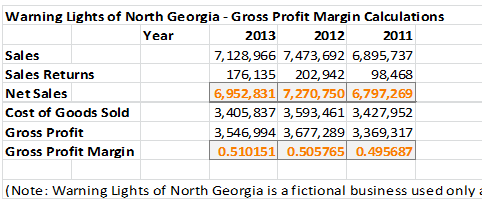
Below is an example of a company that focused on improving its GPM from year to year. For 2011, its GPM was 49.6 percent. For 2013, the number increased to 51.0 percent. In just two years, the company improved GPM markedly. Had the company’s GPM remained static from 2011 to 2013 at 49.6 percent, Gross Profit for 2013 would have been lower by more than $102,000 lower.  

Although incremental improvement to GPM can be difficult to achieve, when accomplished it is truly a gift that keeps on giving.  The $102,000 in higher profits (and cash flow) that Warning Lights of North Georgia achieved during the past two years should continue in future years.  Improving GPM might come from finding new and lower cost sources of raw materials or re-engineering processes—without harming product quality.

Let’s do an example to illustrate the importance.  If your GPM percent is 40% and your overhead costs that you need to cover each month regardless of whether you sell anything is $100,000, then how much business do you need to generate just to breakeven for the month?

If you don’t know the answer to this question, it could mean the difference between losing money or making money.  In our example above, it would require the business to generate $250,000 in revenue to cover its overhead costs.  How did we come to this conclusion?  Using the following formula:

  • $100,000 overhead cost / 40% = $250,000

Keep a close eye on your GPM because it can make the difference between operating at a profit or at a loss.

Here are some Numbers Coach tools to help you calculate your GPM:

Tool kit

“8 Essential Numbers” online course

Filed Under: Blog, Business Growth, Financial Metrics, Financial Tools, Numbers Coach University Tagged With: financial leadership, financial metrics, gross profit margin, numbers coach

Numbers Coach Helps Education Company Communicate Game Plan to Team Leaders

April 18, 2024 by greenmellen

About The Company

Green Building Education Services (“GBES”) is a leading educational services firm that provides the number 1 LEED exam prep solution since 2007.  GBES has served over 150,000 customers with comprehensive solutions to help people advance their careers with the sustainability credentials.  Not only does GBES help its customers pass the LEED exam to get their credentials, but it also continues to support them with continuing education credits to keep their credentials active and relevant.  GBES also provides Well AP certification exam prep and continuing education.  (To learn more, visit the GBES Website at www.gbes.com)

The Situation

In 2020 the GBES team wanted to enhance understanding across the organization for their financial results.  They wanted to find a platform that could communicate the company’s key performance indicators (“KPI”) and help educate its team leaders on what drives the company’s financial results.  In addition, the GBES team wanted a road map that could guide them as they made financial decisions impacting their growth strategies.

The Solution: Numbers Coach Leadership and Numbers Navigator Services

The Numbers Coach’s financial leadership services were an ideal fit for GBES.  Numbers Coach Mike Iverson developed a financial scorecard to focus on the financial measurements that drive company profits and cash flow critical to sustained profitable growth.  The scorecard offers the GBES team an “at a glance” view of results. The Numbers Coach developed a financial model from its proprietary software, the Numbers NavigatorR .  The software provides a road map for the GBES team to see where they are positioned with profits and cash flow.  In addition, the software’s rolling financial forecast gives the GBES team a tool to make critical decisions and see where they are headed financially.

 Results

The Numbers Coach pulled together financial and non-financial data to complete a scorecard and financial model.  Each month, the Numbers Coach meets with the GBES team to methodically review results and provide the input and analysis from the Numbers NavigatorR software.  From the monthly financial coaching meetings, the GBES team has been able take actions on activities that improve the company’s bottom line results and get the team to all row in the same direction.

For more information on Green Building Education Services visit www.gbes.com

To learn more about the Numbers Coach services, click here

“Mike has become an important part of our team.  His approach to educating us on our financial results gives our team the right tools to help us understand how to navigate our finances successfully and stay focused on our financial goals.”  

Dean D’Angelo, President

Filed Under: Business Growth, Case Study, Cash Flow Planning, Financial Metrics, Financial Modeling, Key Performance Indicators, Own Your Numbers Tagged With: business financial planning, coaching executives, financial coaching, financial leadership, financial management, leadership coaching, numbers coaching

3 Tips For Better Business Planning

April 28, 2023 by Mike Iverson

Planning is a critical part of making sure your business is focused and on track.  Here are six important elements for long term planning.

  • Define the outcome.  Each planning session should have a desired outcome in mind that you define at the beginning of it and then circle back at the end and ask yourself the question if you actually addressed it.
  • SMART goals need to be the prepared and documented.  Your management team should come up with what they feel from their perspective the goal or goals should be so that you can see where the common ground is and where your team is thinking the business should go.
  • Have a specific written agenda prepared ahead of any planning session and stick to it.  Don’t let meetings drag on without keeping people on time which means on track.

Follow these 3 guidelines for your next business planning session and create a better road map to your success!

Mike

Filed Under: Business Growth, Cash Flow Forecasting, Cash Flow Planning, Financial Modeling, Key Performance Indicators, Numbers Coach TIPS, Rolling Cash Flow Forecast, Rolling Financial Forecast Tagged With: business financial planning, financial education, financial habits, financial leadership, financial management

3 Tips To Being A Successful Entrepreneur

April 28, 2023 by Mike Iverson

Entrepreneurs and businesspeople are constantly on the go and one of the keys to our success often gets neglected- exercise.  Its important to invest in ourselves and exercise is not only good for our body it really helps our brain development too.  Even only 20 minutes of exercise a day makes a huge impact on our well being and outlook.  Here are some tips.

  • Get adequate sleep.  Sleep deprivation suppresses your brain’s ability to filter distractions and limits your focus.
  • Disconnect from our wired 24/7 world.  Unwinding in nature can dramatically improve your cognitive levels.  I really enjoy hiking or even walking in my neighborhood green spaces.
  • Look at your food intake and make a 2% change.  One of the presentations at my Vistage meeting was a nutritionist.  The one take away that has stuck with me was his mantra of saying find the one thing that you can do to change your diet.  I choose to make sure when I look at labels in the store to limit my sugar intake which converts to fatty carbs.  If I make a 2% change in my diet every year, then after 10 years I have may 20% change in my habits.  That’s much easier than the New Year’s resolution to change everything.

So take a break, get the sleep you deserve, and find a 2% change in your diet that can make a difference in the long run. Here’s to adopting the traits of a successful entreprenuer!

Mike

Filed Under: Business Growth, Leadership, Numbers Coach TIPS, Productivity Management Tagged With: business owner, entreprenuership, financial leadership, leadership, leadership characteristics, leadership traits

7 Habits That Make Great Leaders

April 26, 2023 by Mike Iverson

I recently completed the book “7 Habits of Highly Effective People.”  There were so many great points for both personal and professional development.  The author, Stephen Covey, also provided a list of behaviors that he (and me) believes show in high trust leaders.

1. Give straight talk.  Integrity starts with giving an honest opinion, the truth.

2. Show respect in all that you do, including compassion

3. Right any wrongs, and then apologize to demonstrate humility. Covering up only makes it worse.

4. Get better at it.  Try to continuously learn about new skills and methods.  I read books and magazines on a regular basis with goals of completing a number of books each year.

5. See reality for what it is and take it head on.  Addressing the tough issues shows courageous leadership.

6. Listen first which is one of Covey’s 7 habits of “see first to understand before being understood.”

7. Keep commitments.  Once you state your intentions, keep them to build confidence and trust.

Here’s to creating your 7 habits as a great leader!

Mike

Filed Under: Business Growth, Employer Tips, Human Resources, Leadership, Numbers Coach TIPS, Personal Development, Productivity Management Tagged With: financial leadership, leadership characteristics, leadership strategy, leadership style, leadership traits

Servant Leadership

April 26, 2023 by Mike Iverson

Servant leader- what is it?  In a business movement introduced in the early 70’s is the idea of servant leader.  These leaders put their company or organization before themselves.  They don’t view employees as the means to the end but rather the employee’s satisfaction is the end.  This can be a big shift in thinking for an entrepreneur.  Some points on leaders adopting this style.

  • Treat employees like customers, and where reasonable do their bidding
  • Ask the question “how can I help you?”
  • Fill in for an employee and do their job to lift a burden from the employee’s colleagues
  • Lead like you are leading a group of volunteers and ask, “what problems do you have?”  Volunteers don’t have to listen to autocratic leaders.

Servant leadership does not necessarily say you are a great boss, but rather its realizing that being a boss and leading are not the same.

Here’s to adopting servant leadership traits to build a better company!

Mike

Filed Under: Business Growth, Employer Tips, Human Resources, Leadership, Numbers Coach TIPS, Personal Development Tagged With: CEO leadership, financial leadership, leadership, leadership characteristics, leadership strategy, leadership style, leadership traits

The 7 P’s of Evergreen Companies

April 26, 2023 by Mike Iverson

I read an article recently by Bo Burlingham an INC magazine writer, about what he described as an evergreen company.  The definition is described as a “private, profitable, market- leading businesses that are designed to remain unsold and independent for a long, long time.”   It was interesting to read about entrepreneurs who had decided that it was not about how high the could get their valuation, how much money they raised, or how big they would grow, but rather looking for a meaningful experience building their companies.

Here are seven tips on building an evergreen company.

  • Purpose

Passion driven organization from its vision/mission.  It’s not about the money.

  • Perseverance

The resiliency to keep pushing forward and overcome obstacles

  • People First

Have an engaged workforce aligned with its culture.  Team members who are taken care of will in turn take care of your customers, suppliers, community, and stockholders

  • Private

Taking advantage of the long-term view as a private enterprise

  • Profit

Success is measured and that includes the bottom line

  • Paced Growth

The discipline to focus on growth that is steady and consistent.  Every company has a speed limit to profitable growth

  • Pragmatic Innovation

Embrace the mantra of continuous improvement and be willing to take calculated risks that don’t jeopardize the company

Here’s to knowing how you can drive your evergreen company to the results that you want!

Mike

Filed Under: Business Growth, Business Planning, Cash Flow Planning, Employer Tips, Financial Modeling, Key Performance Indicators, Numbers Coach TIPS Tagged With: business financial planning, business strategic planning, company planning, financial leadership, strategic planning

Want the Secrets to Building a Great Company?

April 26, 2023 by Mike Iverson

I enjoy reading books of all types, both fiction and nonfiction.  Lately, several books captured my attention more than others, one of which is The Traveler’s Gifts, by Andy Andrews.  Its written as a story about principles that to me seem timeless.

Here are the gifts (tips) that I came away with.

  • The buck stops here.  We are responsible for the past, present, and future
  • I will seek wisdom and be a servant to others.  My experiences become the collective body of wisdom that can be shared
  • I am a person of action.  Seize the moment and choose now
  • My destiny comes from a decided heart.  Have a clear vision
  • It’s a choice to be happy and possess the spirit of gratefulness
  • Greet the day with a forgiving spirit, which most of all means to forgive yourself
  • I will persist without exception, great leaders like Churchill persist through adversity.

These are a few gifts that can provide the foundation to building a great business from your passion.

Here’s to all the gifts that you will share to aid in the health of your business!

Mike

Filed Under: Business Growth, Business Planning, Employer Tips, Leadership, Numbers Coach TIPS, Personal Development Tagged With: business financial planning, business strategy, company strategy, financial leadership, leadership, leadership traits, strategic planning

  • 1
  • 2
  • 3
  • 4
  • Next Page »
NumbersCoach_Logo_green-gray_stacked

Proud Supporter of

Screenshot 2025-09-09 150120

Get Financial Tips Delivered To Your Inbox

Protect your business' financial health with our monthly financial tips.

Contact Info

P.O. BOX 250
Decatur, GA 30031

404-353-2148

info@numberscoach.net

© 2026 Trillium Financial, Inc
Privacy Policy | Accessibility | Terms