NumbersCoach_Logo_Endorsed_UnderLogotype_2
  • Numbers Coaching
    • The Numbers Navigator®
    • Case Studies
  • About
    • Trillium-Numbers Coach Story
  • Resources
    • Blog
    • Numbers Coach TIPS
    • Podcasts
    • Numbers Coach Tools
  • Numbers Coach University
  • Contact
  • Search

Understanding Your Cash Conversion Cycle

May 14, 2026 by greenmellen

For small businesses, cash flow is one of the most important determinants of business success.  There are many metrics used to monitor cash flow, one of which is the Cash Conversion Cycle (CCC). We coach all of our clients to track CCC as a key metric.

The CCC measures a company’s effectiveness at converting its investment in inventory into cash. The cycle typically involves purchasing inventory inputs on credit (Accounts Payable), selling the inventory through sales on credit (Accounts Receivable), and converting inventory back into cash. The lower the number of days in the CCC, the more effective management is at generating cash flow from the sale of its product or service.

How the Cash Conversion Cycle Is Calculated

The formula is comprised of three figures.
•    Number of “Days Inventory On Hand” (DIO)
•    Number of “Days Sales Ooutstanding” (see article on DSO here)
•    Number of “Days Payable Outstanding” (DPO)

The formula for calculating the Cash Conversion Cycle (CCC) is:

CCC = DIO + DSO – DPO

DIO, DSO and DPO represent the three component stages of the conversion cycle.  For a service company the cycle would only include the DSO and the DPO metrics.

Breaking It Down

Let’s look at each stage of the CCC to understand the relationships:

  1. The DIO stage measures the time (in days) required to turn over one complete inventory.  DIO can be calculated using figures taken from the annual financial statements; Inventory from the balance sheet and Cost of Sales from the income statement. It is calculated as:
    DIO = Inventory /Cost of Sales x 365
    The idea is to minimize the DIO by turning over inventory as quickly as possible. Selling inventory converts the owner’s investment in inventory into Accounts Receivable, or directly into Cash in the case of cash sales at a retail store.
  2. The DSO stage measures the number of days needed to collect the Accounts Receivable. Using the Accounts Receivable figure from the year-end balance sheet and the Net Credit Sales from the annual Income Statement, it is calculated as:
    DSO = Accounts Receivable/Net Credit Sales x 365
    Like DIO, a business owner wants to minimize DSO. DSO measures how quickly the business is able to convert a credit sale into cash.
  3. The DPO stage measures the number of days it takes to pay vendors for the inventory purchased or expenses incurred to deliver your product or services. Using the Accounts Payable figure from the year-end balance sheet and the Cost of Sales from the Annual Income statement, it is calculated as:
    DPO = Accounts Payable/Cost of Sales x 365
    In contrast to the DIO and DSO stages, business owners want to maximize DPO. A business improves its cash position by holding onto cash longer. Cash flow benefits, of course, must be carefully measured against a company’s payment terms with vendors.  Its important to maintain good relationships with your vendors because they help you grow your business.

The Cash Conversion Cycle metric is most useful in comparing a company’s cash flow performance this year against the performance in previous years, or against competitors’ performance.   By monitoring the trends of the CCC metric, you can spot potential cash flow issues before they become a crisis.


Filed Under: Blog, Cash Flow Forecasting, Cash Flow Planning, Financial Metrics, Financial Modeling, Key Performance Indicators Tagged With: business financial planning, cash flow forecast, cash forecasting, cash planning, preserving business cash, preserving cash, uncertain cash flow

Numbers Coach Identifies Opportunities for Improved Cash Flow for Environmental Engineers

April 21, 2026 by greenmellen

THE COMPANY

In 1996, Scott Pate launched Sierra Piedmont (“SPI”) with a vision to create a superior environmental consulting, site assessment, compliance, and remediation services firm. Since then, SPI has served a wide range of companies from Fortune 100 businesses to regional firms throughout the United States. SPI’s innovative solutions and advice have helped its clients solve their environmental issues.

SITUATION

Pate and SPI’s management team wanted to realize improved cash flow in their day-to-day operations. However, they were not clear on which financial metrics were truly driving the business and needed more meaningful insights beyond the Profit & Loss statement.

SOLUTION: The Numbers Navigator™

SPI hired the Numbers Coach to provide a comprehensive analysis of its financial operations.The Numbers Coach (“NC”) uses its proprietary Numbers Navigator™ tool set to determine the key financial drivers in SPI’s business model. NC gained a further understanding of SPI’s key business issues through a discovery session with management. NC provided Pate and his team with a comprehensive financial report that identified opportunities to drive more cash flow from the business.

RESULTS

Together, NC and SPI determined realistic and actionable strategies to realize improved cash flow quickly. To achieve this goal, NC provided:

  • A 20+ page financial report detailing key drivers in SPI’s business model,
  • A systematic cash flow forecasting model to provide SPI visibility into its future cash flow,
  • “What if” scenarios analyzed to understand the impact of different financial strategies,
  • Establish guiding principles for disciplined cash flow management process
  • A short-term planning tool to ensure resources and cash were allocated appropriately

“Although it sounds cliché, Numbers Coach and the Numbers Navigator™ truly changed our financial life!” explains Pate.  “The fact is, for many years we had little or no ability to perform high level “what-ifs” or projections of cash effects based on pulling different levers in the company.”

“I don’t know of another program quite like this one,” says Pate. “It doesn’t seem boilerplate or ‘canned.’  I think the most benefit is received by using the Navigator in conjunction with Numbers Coaching services to understand how to apply what is revealed by the report to our financial metrics.”

To learn more about Sierra Piedmont, visit www.sierrapiedmont.com

To learn more about the Numbers Coach financial leadership services, click here

Filed Under: Case Study, Cash Flow Forecasting, Cash Flow Planning, Financial Modeling, Financial Tools, Numbers Coaching Tagged With: cash conversion cycle, cash flow forecast, cash forecasting, cash planning, financial analysis, financial education, financial leadership, financial management

Head off Financial Stress with a 90-Day Cash Flow Forecast

March 4, 2026 by greenmellen

Short-term cash flow challenges are very common among small businesses. When a business responds poorly to a cash flow challenge, its ability to continue operations may be jeopardized. Unfortunately, a poor reaction to a cash flow challenge is what often happens.

A common approach is for a business with tight cash flow to monitor its cash balance daily and estimate accounts receivable for the next several weeks. The problem with that approach is that it doesn’t help you as the owner prepare for a cash crunch due to hit four to twelve weeks in the future. That’s why we recommend clients use a 90-day cash flow forecast.

Rolling 90-Day Forecast

The surest way to avoid an unpleasant cash flow surprise is to use a 90-day rolling cash flow forecast. The forecast usually takes the form of an Excel spreadsheet that shows the expected weekly cash receipts and payments. These are presented line by line and tracked weekly.

To create the forecast requires beginning cash balances, estimated cash receipts, estimated payroll and taxes, estimated operating expenses, payments coming due on notes and leases, and lines of credit.

Creating and updating a 90 day cash flow forecast provides numerous benefits:

  • Visibility into your short-term cash needs
  • Financial discipline in measuring your inflows and outflows of your business; i.e., “What gets measured, gets managed.”
  • Insights into your operations and its short-term flow of activities

Estimating Cash Inflows and Outflows

Inflows

Estimating cash receipts for a 13-week period is one of the more difficult components of the model.  Whether your customers pay in a timely manner is typically a function of their own cash flow positions.  Don’t be deterred from making your best estimates, knowing that actual receipts will differ from your estimates. Use recent payment performance of each customer as a guide.

Depending on the number of customers involved, you may want to create a line on the spreadsheet for your largest customers to identify their specific collection pattern independent of the rest of your customers. Alternatively, if your customer base has numerous small customers, you may want to create a separate tab that provides a general pattern of collection from your monthly sales.

Outflows

Payroll and related taxes are generally easier to estimate because for most businesses, the figures may not change much week to week or they change in a predictable manner. Payrolls that include commissions are more difficult to estimate.  One way to estimate commission would be to obtain a historical trend of commission expense as a percent of sales. Then using this percent apply it to the collected sales or billed sales (whichever the commission is based on) subject to commission and put the amount in the period you expect to pay it.

Cash outflows for accounts payable and operating expenses can be easier to forecast.  We recommend laying out the general timing of when you typically pay an expense. For example, office rent is typically due on the 1st of each month.  In this case, you may show the payment as an outflow in the last week of the prior month to ensure the check arrives on the due date.  If you see headwinds ahead in your cash flow, keep your vendors apprised of your ability to pay and reward their patience as best you can.

Stay in Control of Cash Flow

Business conditions change quickly today.  Keeping a tight rein on cash flow is a small business survival skill and the life blood of a company. The 90-day rolling forecast is a good tool that can help you stay in control of your cash flows. For a forecast to be accurate and relevant, it should be monitored on a regular basis and updated with forecast compared to actual. See where the differences occur and adjust your forecasting for any trends that you see. When the forecast is used this way, it becomes a tool for active management of a business’s cash position.

If you need help putting together your forecast, contact us or check out our Cash Flow Tool Kit

Filed Under: Blog, Business Planning, Cash Flow Forecasting, Cash Flow Planning, Financial Modeling, Rolling Cash Flow Forecast Tagged With: cash flow, cash flow forecast, cash forecasting, cash planning, financial management

Want More Cash Flow? Check your Accounts Receivable Cycle

April 13, 2023 by Mike Iverson

I sometimes hear from business owners that they are making a profit, but they don’t seem to have positive cash flow at the end of the year. What happened?

Your business may generate a positive net income, but if you aren’t monitoring other key cash flow drivers, then you can find yourself strapped for cash to meet the obligations of the business.

One of those drivers that can cause a lack of cash is your Accounts Receivable (A/R) collection cycle. It’s one of the four pillars that drive cash flow (along with Accounts Payable, EBITDA, and Inventory Days-on-Hand)

Your Accounts Receivable Cycle

Many businesses offer customers the ability to “Buy Now, Pay Later” for their purchases. In other words, they are providing customers a short-term interest free loan to pay for the product or service! If your customer doesn’t pay on time or takes longer than you expect, it can create a cash flow problem in your business.

Monitoring how long it takes for you to collect your accounts receivable is important. The quicker you can collect it, the quicker you get the cash you need to pay your bills and reinvest for your company’s growth.

But how do you measure it? Below is a formula to determine your collection cycle. Keep in mind your cycle will shift weekly, monthly, quarterly, etc… The calculation is merely a “snapshot in time,” but it’s important to know.

Formula:
Annual sales / 365 days= daily sales
Accounts receivable balance / daily sales= days to collect accounts receivable

Example:
$1,000,000 / 365 days= $2,740 daily sales
Accounts receivable $80,000 / $2,740= 29 days

In the above example, it takes on average about 30 days to collect the amounts owed by the company’s customers. If this metric increases from 29 days to 39 days, then the extra 10 days has left the company with $27,400 less cash in their bank account than if they had collected it in 30 days. This is where the business owner could see a positive net profit in the profit and loss statement, but also see that their cash balance has decreased by $27,400.

Know your accounts receivable collection cycle. Calculate it on a regular basis, such as monthly. Identify customers who are consistently not paying on time and determine a strategy to encourage them to pay within the terms you have offered. It can be the difference between positive or negative cash flow!

For more resources to help you measure this important metric, check out our Numbers Coach tools and templates.

Filed Under: Cash Flow Planning, Financial Metrics, Key Performance Indicators, Numbers Coach TIPS Tagged With: accounts receivable management, business cash flow, cash conservation, cash flow forecast, cash forecasting, cash planning, collection pattern, collection tips, key performance indicators, preserving cash, uncertain cash flow, working capital management

Want More Cash Flow? Check your EBITDA

February 9, 2023 by Mike Iverson

The life blood of any business is its ability to generate solid cash flow. Without positive cash flow, a company will eventually go out of business. This TIP will focus on one of four key pillars that drive cash flow. In this case we will look at “Earnings Before Interest, Taxes, Depreciation, and Amortization,” or more commonly known by the moniker EBITDA.

Where do you find this metric? One of the financial statements that you can get from your accounting system is the profit and loss statement. The very last number of this statement is typically labeled “net income.” Net income is the profit you have left over after paying all your expenses. When we add back to net income the interest expense, depreciation expense, amortization expense, and income tax expense we get the number for EBITDA.

EBITDA formula:

Net income +

  • Interest expense
  • Depreciation expense
  • Amortization expense
  • Income tax expense

= EBITDA

EBITDA is important for two reasons:

  1. It is a general indicator of your company’s ability to generate cash flow from the operations of your business
  2. It is used as part of the formula for valuing a business. Often someone who wants to buy a business will value it based on a “multiple” of EBITDA. In other words, they are buying your company’s ability to produce cash flow now and into the future.

To generate positive cash flow, you need to have a positive EBITDA. Otherwise, you are generally finding yourself starting your cash flow conversation in the negative position and will likely need to borrow money or find investors to provide capital to keep the company going.

Start with a positive EBITDA number and you can be more confident with your company’s ability to generate positive cash flow. Do you know your EBITDA?

Let us know if we can help you with this important metric.

Filed Under: Business Growth, Business Planning, Cash Flow Planning, Financial Metrics, Financial Modeling, Numbers Coach TIPS, Rolling Financial Forecast Tagged With: cash flow, cash flow forecast, cash forecasting, cash planning, ebitda, net income, uncertain cash flow

What Your Inventory Turnover Ratio Is Telling You

May 6, 2022 by greenmellen

Bankers who lend to small businesses in manufacturing and distribution often calculate a client’s inventory turnover ratio. “What are the bankers looking for in a ratio?” clients sometimes ask.

First, bankers wonder whether the business is carrying inventory that is disproportionate to its sales. Carrying excess inventory is not a productive use of capital when money is tied up in product that sits on a shelf and incurs warehouse costs.

A second concern for lenders is that inventory not turned over quickly will become obsolete, damaged, or outdated. In any of those circumstances, revaluation of the inventory is necessary and losses must be booked. That’s a concern to lenders.   Also a decreasing turnover rate could indicate a slowing sales and lower profit trend.

Calculating the Ratio

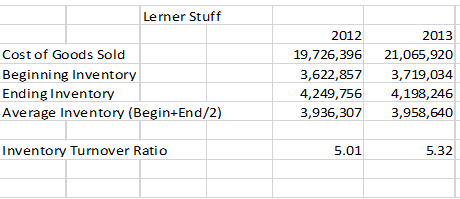
The ratio is only difficult to calculate if a business’s inventory varies significantly throughout the year. Inventory Turnover is calculated as Cost of Goods Sold divided by Average Inventory. The Cost of Goods Sold is always calculated for the Income Statement, so the figure is readily available. Average Inventory may be trickier. For businesses with fairly constant inventory levels, simply add Beginning Inventory to Ending Inventory and divide by two to calculate a simple average.

This simple average doesn’t always work well, however, because many businesses have significantly less inventory at the beginning and end of the year than at other times. The simple average, therefore, uses an artificially low denominator, which tends to overstate the Inventory Turnover Ratio.  So, if monthly inventory figures are available to calculate the average their use will provide a truer Inventory Turnover Ratio:

Using information from the table above, we can calculate Lerner’s Inventory Turnover Ratio for 2012 and 2013. The ratio is determined by dividing Cost of Goods Sold by Average Inventory for each year. For 2012, the calculation is 19,726,396/3,936,307=5.01. For both 2012 and 2013, Lerner turned over its inventory slightly more than five times per year. Bankers interested in Lerner’s Inventory Turnover Ratio would likely compare the Lerner ratio against those of other companies in the same industry. A turnover ratio significantly below those of Lerner’s peer group might cause bankers concern about inventory obsolescence.

Let us know if you would like to see how your ratio stacks up against those of your peers, or to discuss how to improve your ratio.

Filed Under: Business Growth, Business Planning, Cash Flow Planning, Financial Modeling, Key Performance Indicators, Numbers Coach TIPS, Rolling Financial Forecast, Working Capital Tagged With: cash flow forecast, cash forecasting, cash planning, financial metrics, inventory management, inventory turnover, key performance indicators, KPI, preserving cash, working capital management

Reassess Your Customer Credit Practices for Stronger Financials

September 29, 2020 by greenmellen

by Anne Moore Odell

Every time you send out an invoice, it is like you are granting a loan to your clients. Business is built on trust with products and services moving around the world on the foundation that invoices are going to be paid in a timely manner.

However, extending credit can’t happen in a vacuum. It is up to you to create credit policies that keep your cash flow and business healthy. And while having good credit practices in place is always important, it is especially important to make wise credit decisions in today’s difficult economic times.

Here are 5 tips to help you create sound credit policies:

 1. Take the Time to Research

Now is the time to revisit your credit application process. Make sure that your application is thorough. Make the effort to call all supplied references and banks. Although clients are only going to supply positive references, you can still learn a lot about how potential clients work.

Do your homework on prospects by going to the library where free information from publicly traded companies can be found. Consider using a professional credit report service like Dun & Bradstreet , TransUnion or Equifax. For a small fee they can provide credit histories, records of liens against companies, and current financial obligations on larger clients.

“Don’t forget to use your contacts with the various business associations you belong to – they can help gain information about credit decisions,” suggests Mike Iverson, CEO of Trillium Financial. “Through these relationships and through relationships with other vendors, you can learn about potential clients. You might also require information from clients’ accountants, and tax returns,” says Iverson.

2. Consider using a Z-Score 

A Z-Score is a calculation that allows you to figure out the financial health of a company by using ratio values for a “score” that can indicate potential future bankruptcy. A Z-Score calculator can be located at either The Accounts Receivable Network (membership site: www.tarn.com) or at JaxWorks (http://www.jaxworks.com/calc2a.htm )

3. Be Selective

Keep your customers’ credit files up to date. With businesses going bankrupt and changing hands, it is important to update your credit information on existing clients, increasing or decreasing credit limits as needed.
“In this market you need to be discerning regarding who you are offering your services and products to,” says Marc D. Smith, Vice President, Magnolia Financial, Inc, based in Spartanburg, SC. “Fire customers if they don’t meet your credit requirements.”

Because of the reduction in sales that many businesses are seeing across sectors and industries, businesses are facing increased pressures when it comes to extending credit. However, just because a client is interested in your product or service it doesn’t mean that you need to accept every application.

“In my experience, people are lowering some of their credit limits,” says Iverson. “You should consider your accounts receivables to be much like an investment portfolio—you have invested in your customers and you want your portfolio to be profitable.”

Working with customers before problems and outstanding invoices occur is the best approach. In some cases, you can work out new payment schedules. It is also important to include your entire team so that salespeople know clients’ credit and payment histories.

4. Follow Up

“In good or bad times, one of the keys to collecting from customers is timely and accurate billing,” explains Mike Iverson, CEO of Trillium Financial. “That sounds like a no brainer, but sometimes that doesn’t happen. An invoice might have to be approved or reviewed by several different people, which can cause you to lose two, three, or four days in collecting your invoice.”

One effective practice for larger bills is calling to follow up on an invoice two or three days after it is sent to see if everything is in order. This practice not only puts you top of mind with your client but acts as a customer service call that could generate more sales. If the client does have an issue with the bill, then you can quickly solve the problem, generate another invoice and get paid on time.
Another proactive practice is to send monthly statements or even bi-weekly statements, again reminding clients before bills become overdue.

5. Good Relationships are Important

All levels of management are becoming more involved in credit decisions as businesses look to keep the cash coming in. These days CFOs and CEOs are participating in credit decisions with their teams.

One of the main points to remember, however, is that while economic downturns will end, the relationships you form today will continue. Working to preserve the business relationships you have now and creating new working relationships not only generates good will, but also builds a strong foundation to catapult your business when the economy rebounds.

Filed Under: Blog, Business Growth, Business Planning, Cash Flow Forecasting, Cash Flow Planning, Employer Tips, Financial Modeling, Financing a Business, Key Performance Indicators, Rolling Cash Flow Forecast, Rolling Financial Forecast, Working Capital Tagged With: business cash flow, cash flow, cash flow forecast, cash forecasting, collection tips, credit practices, working capital management

Your Best Tool for Understanding Short-Term Cash Flow

September 17, 2020 by greenmellen

In a recent article, I shared ideas on how to positively position your company’s financials, even during a slowing economy.  The key is to ensure you have strong cash stores and credit availability.

Today, I will explain a management tool that helps you anticipate your near-future cash flow and identify any areas of weakness: Presenting the 13-Week Cash Flow Analysis. 

You may already use software that allows you to run regular cash flow analyses. These give a more accurate picture than net profit or bank statements.

Initiate your 13-week cash flow analysis by gathering the data needed to build an accurate report:

  • Current bank account and credit card balances
  • Upcoming mortgage or lease payments
  • Estimated cash receipts
  • Estimated payroll and taxes
  • Estimated operating expenses
  • Any other upcoming transactions that will impact cash flow.

The integrity of the report is dependent on the accuracy of the data as well as it being correctly entered or integrated into a spreadsheet or software. For the variable revenue and expenses you estimate, be sure to keep seasonal influences in mind. And remember, you only need to record and predict 13 weeks out – it’s a short-term tool.

A report with solid data and estimates is a good indication of your cash situation over the next 3 months (or, one full quarter). But check the output against your gut:  If the balance seems overly positive in any or all of the 13 weeks, review your estimates, especially sales and accounts receivable forecasts. Being overly optimistic won’t serve you well – if anything, conservative estimates will give you the padding needed to accommodate unpredictable changes.  If you have the time, run worst-, best- and average-case scenarios.

If the report indicates that your company will be cash poor at points during the next 13 weeks, it’s time to review your options:

  • Do you have unneeded equipment or inventory that can be sold to improve fluidity?
  • Are there expenses that can be eliminated, contracts that can be renegotiated or even dissolved, or payments negotiated or delayed?
  • Is it time to implement a collections push?
  • Is your billing and collections process quick and accurate?
  • Are there any loans available to the business?

Once it is set up, maintaining cash flow history and projections is easy. Monitor and update the report weekly, and review your historical projections against actuals to improve your modeling accuracy.

Cash and cash flow are critical to successful operations, and utilizing 13-week cash flow analyses will help you identify gaps and become better at anticipating your future cash needs to keep your business steady. So make proactive cash flow analysis one part of your flexible, resilient business, whether the economy and your customer demand are swinging up, down, or somewhere in between.

Filed Under: Blog, Business Growth, Business Planning, Cash Flow Forecasting, Cash Flow Planning, Financial Modeling, Rolling Cash Flow Forecast, Rolling Financial Forecast, Working Capital Tagged With: business cash flow, cash flow, cash flow forecast, cash forecasting, cash planning, preserving business cash, preserving cash, uncertain cash flow

Why a Slow Economy Doesn’t Have to Mean Dire Straits for Your Business

May 13, 2020 by greenmellen

Is the slowing economy adversely affecting Atlanta’s businesses, or is it a great time to be in business?

Well that depends mostly on your recent revenues. But even if those are in reverse, a slowing economy can be a great time to take advantage of some opportunities and position your business to come out of the gate at full speed when the economy takes an upswing.

We wanted to hear what local professionals in finance and business had to say about the current state of affairs. CFO service provider Mike Iverson and Vistage Chair Tim Fulton had some good tips for bad times.

Cash is King

The first step to understanding how to make sure your glass is half full is to assess your financial situation and understand exactly how much cash and credit you have. Even if cash flow is good, “Now would be a good time to go the bank,” says Mike Iverson, CPA and Principal of Trillium Financial, “before the economy gets worse or your company financials get worse. Go to the bank and make clear why you want a line of credit and what you will use it for.” It’s important to be proactive when it comes to having the cash stores ready. If you wait until you need it, your statements probably won’t look as good, and the bank may decline a loan or line of credit. Planning ahead is always a good thing. “The key to survival in an economic downturn is to out perform the market, and accumulate cash”, says Tim Fulton, a Vistage International Group Chair which works with over 14,000 chief executives in 16 countries.

Another aspect of understanding your capital position is modeling. How long can your business last with a certain amount of decline? What will you do to make sure you can weather the storm and start growing again? Imagine the various scenarios – even the truly ugly ones – and devise solutions before they come to fruition. You’ll be able to think more clearly in the face of adversity if you have a battle plan and, again, a line of credit to back you up. This doesn’t mean that you have to focus on the worst case scenario, just plan for it, then focus on your everyday business.

Modeling the tough situations is especially important if you are in a cyclical business; for example, the automotive industry. When the economy hits the skids, the average car dealership will probably see sales decline rapidly. Managers must have enough cash reserves to ride out the storm, and to pay for overhead and inventory so they can still be in business a year from now.

If you are a manufacturer, or a company that manages a lot of inventory, be mindful of your production capacity. You don’t want to continue to run at full capacity and end up with an overstock. Go to your clients and continually measure what they anticipate ordering from you in the next two to three months. For production purposes, you might have to scale back so the inventory on hand can be used, and not end up obsolete. On the positive side, manufacturers are usually the first to see orders are picking up. They’re not necessarily the canary in the mine shaft, but these businesses tend to provide a leading indicator.

The Positives of Slower Times

Once your cash situation is well-positioned, the glass is definitely half full. Now is the perfect time to expand your business through capital investments such as acquiring a struggling competitor. You can often take advantage of businesses being sold at fire-sale prices.

“When the economy bottoms out, there will be an abundance of great investment opportunities,” says Fulton. “The business owner with cash will be in a strong position to take advantage of these opportunities.”

Companies with cash can also get the upper hand over competitors by investing in the introduction of new products and in new technology that other business can’t afford. “If you can do any of these things”, says Iverson, “you’ll be in a different place than your competitors because you will be nine to twelve months ahead of them.  You will have something to offer customers that your competitors cannot.”

Companies who differentiate themselves in this way will be growing when everyone else is declining. Constantly look at opportunities to grow with products and services that will serve others struggling with hard economic times and continue to help them through good economic times,” says Iverson.

Another way to grow through a slowing economy is to ramp up marketing. While other companies cut their marketing budgets, Fulton recommends against this instinct. “Be very, very focused in your marketing strategies. This is not a time to be spending a lot of money on broad branding efforts. It is a time to be laser-focused on acquiring new clients and retaining profitable existing clients,” he says.

Iverson agrees. “Marketing is the last place you should cut back,” he says. “Marketing initiatives are priming the pump to create your sales engine. If you cut back on that, you cut back on future sales and opportunities. If everyone else cuts back on marketing, you will stand out even more, possibly turning that half-full cup to overflowing.”

Filed Under: Blog, Business Growth, Business Planning, Cash Flow Forecasting, Cash Flow Planning, Employer Tips, Financial Metrics, Financial Modeling, Own Your Numbers, Rolling Cash Flow Forecast, Rolling Financial Forecast Tagged With: business financial planning, business planning, business strategic planning, cash flow forecast, cash forecasting, cash planning, financial analysis, financial habits, financial management, financial metrics, strategic planning

Solving Your Liquidity Crunch

May 7, 2018 by greenmellen

Sometimes business owners get into difficult situations because they don’t understand the likelihood of crisis and are unprepared when it strikes. One of the most likely kinds of crisis is a liquidity crunch.
​
A liquidity crunch can occur as a result of a customer extending their time to pay you. This event may come unplanned, and therefore, put you in a cash crunch in the short-term. As the saying goes “cash is king.”
​
Sometimes a liquidity crunch is the result of a business decision that doesn’t work according to plan. A business invests in a new product or service line, only to learn that market demand for the new offering is less than expected and the business needs some time to adjust. The money expended may eventually be recouped, but the payback period will be significantly longer than management had planned.
Lining Up a Credit Line
One way to prepare for a liquidity event described above is to line up a source of available cash while the business is flourishing. The best time to get a loan is when you don’t need it. However, in my experience, some business owners delay this process during good times because they are too busy to plan for lean times, then panick when trouble hits. The panic sometimes causes them to drain their personal bank accounts. This is a mistake that must be avoided. Nothing is worse than letting a business difficulty spill into the business owner’s personal life.
A far better option is to pursue a business line of credit, which is an agreement for a lender to provide a specified amount of short-term credit to a business owner for a period of one year or less. The maximum amount of the credit line typically depends on business revenues, the credit history of the business or its owner, their industry, and how long the business has been in operation.
The best thing about a line of credit is the flexibility it offers. I recommend using a line of credit prudently. You should not use it to shore up operating issues that are not getting addressed. It should be for a short period of time with a clear indication on how it gets paid back. You only borrow what you need, when you need it, and you are borrowing only for a short-term time horizon, less than 12 months. If you don’t see how you will be able to pay off the line of credit within the 12 months then it should not be used. Rather you should seek more long-term financing with your bank or other institution.
Where You Borrow and What You Pay
In years past, banks provided virtually all lines of credit. The documentation could be significant, but if you were approved the rate was usually very good. The interest rate charged on a credit line was generally stated as a standard rate like bank prime, plus a small spread for the lender.
Today, the process has changed some given new financial regulations. Many banks may not lend to a small business, unless the owner or business is a long-time customer with other banking needs (checking, savings…). But, it’s well worth asking banks if a business line of credit is available because of the competitiveness of their rates.
A whole new crop of online lenders has emerged to meet the needs of small businesses, including leaders like Kabbage, BlueVine and OnDeck. These lenders usually work with businesses seeking $10,000 – $200,000 as a line of credit. Rates are typically higher than those available from a bank. The range of APRs can easily exceed 18%. If you go down this path, find the right lender that is affordable for you. Be very careful taking on debt that is only “kicking the can down the road” and will ultimately result in a severely limited business operation.
Think of a line of credit as an insurance policy. You hope that tapping it won’t be necessary. But, when you face a liquidity crunch, you’ll be glad to have it. Remember, liquidity is a lifeline that might well save your business.
Have you considered a line of credit for your business? Call Trillium Financial. We can help you avoid the hazards and find the lender that best meets your needs.

Filed Under: Blog, Business Growth, Business Planning, Financing a Business, Rolling Cash Flow Forecast, Rolling Financial Forecast, Working Capital Tagged With: business cash flow, business financial planning, business strategy, cash flow, cash flow forecast, cash forecasting, cash planning, company strategy, strategic planning

Numbers Navigator Helps Pool Company Float More Cash to the Bottom Line

November 3, 2017 by greenmellen

About the Company

Bill White built Southern Splash Pools (“SSP”) in 2001 to provide northern Georgia with quality custom and new pool construction, pool repair and maintenance services.  SSP provides a lifetime structural guarantee with all of its installations.

The Situation

Over the years, Bill realized that his profits weren’t where he thought they should be, but couldn’t identify exactly why:  “At the end of the day, our overall sales numbers were good, but the bottom line was not.”

The Solution

Intrigued by information about the Numbers NavigatorR he found in the Numbers Coach (“NC”) monthly newsletter, White decided to “pull the trigger” and contacted NC’s, Mike Iverson, to provide a comprehensive analysis of SSP’s financial operations.  Iverson used the Numbers NavigatorR to determine the key financial drivers in SSP’s business model, then conducted a discovery session with management to gain an understanding of their key business issues.

NC provided SSP with a comprehensive financial report that identified opportunities to drive more cash flow from the business.  Together the Numbers Coach and SSP determined that margins were too thin, and that pricing per project needed to be adjusted to reach the profitability desired by SSP.  To achieve this the Numbers Coach provided:

  •  A 20+ page financial report detailing key drivers in SSP’s business model
  • Cash on hand/revenue targets for each month
  • Models for various pricing strategies and guidance on creating the pricing structure that would provide more profitability
  • Provided a short-term planning tool to ensure resources and cash were allocated appropriately
  • Established a schedule for accountability check-ins to measure progress on financial goals


“I appreciate Mike’s approach, which is educational and ‘real world;’ he boils it down to
what I really need to know to run my business. The best part is that I now understand
what the numbers are telling me and I have someone besides myself to hold me
accountable for reaching my financial goals.”


Bill White, President, Southern Splash Pools

Filed Under: Business Growth, Business Planning, Case Study, Cash Flow Forecasting, Cash Flow Planning, Financial Metrics, Financial Modeling, Financing a Business, Rolling Financial Forecast Tagged With: business cash flow, business financial planning, cash flow, cash flow forecast, cash forecasting, cash planning, financial education, financial management, preserving cash

Cash Flow Management: Now More Important Than Ever

May 19, 2016 by greenmellen

From “Mom&Pop” companies to major corporations, businesses today are looking at every penny flowing in and out.  No one relishes turning up the heat on clients to pay invoices faster. That’s why you should implement proactive cash flow management practices—before your bills start to pile up and your lines of credit are tapped out.

Conduct a Cash Flow Analysis

Cash flow controls the extent to which a business builds or consumes available cash and credit capacity.  Cash flow analysis is not simply an interesting management tool. It is necessary for the good health and future of every enterprise.

“At the end of the day, well-run businesses will use cash flow analysis as a tool to manage their destiny by preparing for future needs,” says Joe Dresnok, President of Management Horizons in Roswell, GA.  “For those companies that have the wisdom to keep either cash or credit resources available beyond the resources that they currently anticipate, those firms will likely have the ‘staying power’ to withstand the machinations of this turbulent economy.”

Your business software may already have built-in features that allow you to run regular cash flow analyses.  These analyses give a larger and more accurate picture than net profit or bank statements.

Use Cash Flow Forecasting

Run several different cash flows forecasts for your business: a best-case scenario, a worst-case scenario, and a middle case scenario.

“When thinking about cash flow management, a thirteen week rolling forecast is a very useful tool,” says Mike Iverson, CEO of Trillium Financial. “Today is the first week of the 13-week cycle. Use this tool to think about where you will be in three months.”

While economic turbulence does make it more difficult to predict exactly what your business will look like in three months, running these forecasts tells you if you will be able to pay bills, and help you create plans to be proactive in managing your cash flow requirements.

If you feel overwhelmed by a thirteen week period, then Iverson suggests “running a shorter one, for example an eight week cash flow forecast.”

“Cash flow projections is a valuable tool,” explains Dresnok. “It can mean the difference between success and failure – even for a growing business.  In short, cash flow projection can guide the business owner to controlled, profitable growth.”

Extend Credit Carefully and Invoice ASAP

“In light of the recent slow-down in the economy, many companies are experiencing declining revenues, slower collections of outstanding accounts receivable – or even write-offs– and less access to bank financing,” says Kent Bridges, CPA, Managing Partner of Bridges & Dunn-Rankin, LLP, headquarters in Atlanta, GA.  “Accordingly, businesses are having to be more proactive in their billing and collection practices including doing more to determine the credit worthiness of customers before extending them credit.”

Two of the best cash flow management techniques are (1) having policies in place on extending credit to customers and (2) having good billing practices.

Iverson suggests one tool to consider as part of your credit evaluation process is the Z-Score.  It is one of several tools that you can use to assist with the dilemma of who you should or should not extend credit. The Z–Score is a mathematical calculation used to rate companies’ creditworthiness.  You can find additional information about this methodology at the following resources:
•    The Accounts Receivable Network (www.tarn.com)
•    Credit Guru.com (www.creditguru.com)

In a cash-tight economy, fast and accurate invoicing is especially important as a good billing practice. Send your invoices as soon as possible. Don’t wait to send them out at the end of the month.

Make sure all the info on the invoice is accurate so that you don’t need to reissue a bill. One of the biggest issues for small and medium sized businesses for positive cash flow management is closing on the cash conversion cycle.  The conversion is the time between when a service or product is delivered until payment is received.

Cash in Hand

Other cash flow management tools include appropriate use of debt financing and maintaining sufficient cash reserves.

“While it varies according to the business, we generally recommend having cash in operating accounts equal to at least one to two months of operating expenses, having another one to two months of operating expenses covered by accounts receivable or recurring revenue, and another one to two months of operating expenses covered by available lines of credit” suggest Bridges.  “This provides the company with a minimum of three to six months of cash flow cushion in the event of a slow-down in revenue or collections. “

Remember: even fast-growing companies can have cash flow issues as they add new employees and equipment, making cash flow management important for all businesses in both good and tough economic environments.

Filed Under: Blog, Business Growth, Cash Flow Forecasting, Cash Flow Planning, Employer Tips, Key Performance Indicators, Rolling Cash Flow Forecast, Rolling Financial Forecast, Working Capital Tagged With: business cash flow, business financial planning, business planning, cash flow, cash flow forecast, cash forecasting, cash planning, strategic planning

  • 1
  • 2
  • Next Page »
NumbersCoach_Logo_green-gray_stacked

Proud Supporter of

Screenshot 2025-09-09 150120

Get Financial Tips Delivered To Your Inbox

Protect your business' financial health with our monthly financial tips.

Contact Info

P.O. BOX 250
Decatur, GA 30031

404-353-2148

info@numberscoach.net

© 2026 Trillium Financial, Inc
Privacy Policy | Accessibility | Terms