NumbersCoach_Logo_Endorsed_UnderLogotype_2
  • Numbers Coaching
    • The Numbers Navigator®
    • Case Studies
  • About
    • Trillium-Numbers Coach Story
  • Resources
    • Blog
    • Numbers Coach TIPS
    • Podcasts
    • Numbers Coach Tools
  • Numbers Coach University
  • Contact
  • Search

Understanding Your Cash Conversion Cycle

May 14, 2026 by greenmellen

For small businesses, cash flow is one of the most important determinants of business success.  There are many metrics used to monitor cash flow, one of which is the Cash Conversion Cycle (CCC). We coach all of our clients to track CCC as a key metric.

The CCC measures a company’s effectiveness at converting its investment in inventory into cash. The cycle typically involves purchasing inventory inputs on credit (Accounts Payable), selling the inventory through sales on credit (Accounts Receivable), and converting inventory back into cash. The lower the number of days in the CCC, the more effective management is at generating cash flow from the sale of its product or service.

How the Cash Conversion Cycle Is Calculated

The formula is comprised of three figures.
•    Number of “Days Inventory On Hand” (DIO)
•    Number of “Days Sales Ooutstanding” (see article on DSO here)
•    Number of “Days Payable Outstanding” (DPO)

The formula for calculating the Cash Conversion Cycle (CCC) is:

CCC = DIO + DSO – DPO

DIO, DSO and DPO represent the three component stages of the conversion cycle.  For a service company the cycle would only include the DSO and the DPO metrics.

Breaking It Down

Let’s look at each stage of the CCC to understand the relationships:

  1. The DIO stage measures the time (in days) required to turn over one complete inventory.  DIO can be calculated using figures taken from the annual financial statements; Inventory from the balance sheet and Cost of Sales from the income statement. It is calculated as:
    DIO = Inventory /Cost of Sales x 365
    The idea is to minimize the DIO by turning over inventory as quickly as possible. Selling inventory converts the owner’s investment in inventory into Accounts Receivable, or directly into Cash in the case of cash sales at a retail store.
  2. The DSO stage measures the number of days needed to collect the Accounts Receivable. Using the Accounts Receivable figure from the year-end balance sheet and the Net Credit Sales from the annual Income Statement, it is calculated as:
    DSO = Accounts Receivable/Net Credit Sales x 365
    Like DIO, a business owner wants to minimize DSO. DSO measures how quickly the business is able to convert a credit sale into cash.
  3. The DPO stage measures the number of days it takes to pay vendors for the inventory purchased or expenses incurred to deliver your product or services. Using the Accounts Payable figure from the year-end balance sheet and the Cost of Sales from the Annual Income statement, it is calculated as:
    DPO = Accounts Payable/Cost of Sales x 365
    In contrast to the DIO and DSO stages, business owners want to maximize DPO. A business improves its cash position by holding onto cash longer. Cash flow benefits, of course, must be carefully measured against a company’s payment terms with vendors.  Its important to maintain good relationships with your vendors because they help you grow your business.

The Cash Conversion Cycle metric is most useful in comparing a company’s cash flow performance this year against the performance in previous years, or against competitors’ performance.   By monitoring the trends of the CCC metric, you can spot potential cash flow issues before they become a crisis.

Filed Under: Blog, Cash Flow Forecasting, Cash Flow Planning, Financial Metrics, Financial Modeling, Key Performance Indicators Tagged With: business financial planning, cash flow forecast, cash forecasting, cash planning, preserving business cash, preserving cash, uncertain cash flow

Want More Cash Flow? Check your Accounts Receivable Cycle

April 13, 2023 by Mike Iverson

I sometimes hear from business owners that they are making a profit, but they don’t seem to have positive cash flow at the end of the year. What happened?

Your business may generate a positive net income, but if you aren’t monitoring other key cash flow drivers, then you can find yourself strapped for cash to meet the obligations of the business.

One of those drivers that can cause a lack of cash is your Accounts Receivable (A/R) collection cycle. It’s one of the four pillars that drive cash flow (along with Accounts Payable, EBITDA, and Inventory Days-on-Hand)

Your Accounts Receivable Cycle

Many businesses offer customers the ability to “Buy Now, Pay Later” for their purchases. In other words, they are providing customers a short-term interest free loan to pay for the product or service! If your customer doesn’t pay on time or takes longer than you expect, it can create a cash flow problem in your business.

Monitoring how long it takes for you to collect your accounts receivable is important. The quicker you can collect it, the quicker you get the cash you need to pay your bills and reinvest for your company’s growth.

But how do you measure it? Below is a formula to determine your collection cycle. Keep in mind your cycle will shift weekly, monthly, quarterly, etc… The calculation is merely a “snapshot in time,” but it’s important to know.

Formula:
Annual sales / 365 days= daily sales
Accounts receivable balance / daily sales= days to collect accounts receivable

Example:
$1,000,000 / 365 days= $2,740 daily sales
Accounts receivable $80,000 / $2,740= 29 days

In the above example, it takes on average about 30 days to collect the amounts owed by the company’s customers. If this metric increases from 29 days to 39 days, then the extra 10 days has left the company with $27,400 less cash in their bank account than if they had collected it in 30 days. This is where the business owner could see a positive net profit in the profit and loss statement, but also see that their cash balance has decreased by $27,400.

Know your accounts receivable collection cycle. Calculate it on a regular basis, such as monthly. Identify customers who are consistently not paying on time and determine a strategy to encourage them to pay within the terms you have offered. It can be the difference between positive or negative cash flow!

For more resources to help you measure this important metric, check out our Numbers Coach tools and templates.

Filed Under: Cash Flow Planning, Financial Metrics, Key Performance Indicators, Numbers Coach TIPS Tagged With: accounts receivable management, business cash flow, cash conservation, cash flow forecast, cash forecasting, cash planning, collection pattern, collection tips, key performance indicators, preserving cash, uncertain cash flow, working capital management

Preserving Cash In Uncertain Times

February 17, 2023 by Mike Iverson

I’ve been watching the news and talking with colleagues and clients and wanted to share some strategies with you for preserving cash that may come in handy.

1. Research refinance options for any high interest loans and ask for some or all of the closing costs to be waived.
2. The Small Business Administration has created a program to fast track low interest loans under its Economic Injury Disaster Loan, visit: www.sba.gov/disaster
3. Reach out to your lenders about deferring payments, or reducing to interest only payments, on debt.
4. Ask your landlord if you can pay rent at the end of the month (in arrears) for the next 90 days.
5. Ask your landlord about reducing or deferring Common Area Maintenance (CAM) charges for the next 90 days.
6. Call clients to see who can pay faster/earlier.
7. Call vendors to see if you can get extended terms or defer some portion of invoices to a later date. 8. Ask vendors to take payment on a company credit card.  Ask the vendor to charge the amount just after the credit card statement drop date.  This can defer a payment from 15-45 days if timed correctly.
9. Reach out to your credit card company to ask for reduced or zero interest for the next 90-120 days. 10. Bill customers as quickly as possible.
11. Consider whether you have any customers who might pay now for future delivery of services.
12. Defer your personal tax return filing and payment to July 15th.  The IRS issued a recent ruling that is allowing a delayed 2019 tax filing until this date.  However, if you are owed a refund, file your return now to get the funds.

Congress is in the process of an enacting special legislation called the “CARES Act” which is in the Senate at this time.

If you think of other ideas, I’d love to hear them!  My belief is that we will come out of this stronger and definitely together.  Scientists around the world will find the path through for our collective well-being.

Stay well!  And if you have any questions, concerns or just want someone to talk through your ideas, don’t hesitate to reach out.    Mike

Filed Under: Business Growth, Business Planning, Cash Flow Planning, Financial Metrics, Financial Modeling, Financing a Business, Numbers Coach TIPS, Rolling Cash Flow Forecast, Rolling Financial Forecast Tagged With: business cash flow, cash conservation, cash flow, preserving business cash, preserving cash, uncertain cash flow

What’s the Deal with Working Capital?

November 3, 2022 by greenmellen

A Unique Look at Asset Based Lending
by Marc Smith

“Cash is King.”  We’ve all heard the expression, but if you haven’t owned your own business, you likely haven’t given it serious thought.

When a business is for sale, most people first want to know about the total revenue (sales) and the net income (profit).  These two factors are extremely important, but any business owner would argue that there is another factor that is even more important than these two:  Operating Cash Flow or Working Capital.  Profits are great, but no matter how much money is coming in the future, a business can’t continue to operate if it doesn’t have enough cash to cover this week’s payroll.

Let’s use an example of a recent business acquisition: 

XYZ Company is acquired by an eager buyer who uses an SBA Loan to finance the transaction.  Everything starts out great for the new owner:  their new business is growing, sales are up and they are enjoying the rewards of self-employment.  XYZ Company has many new orders to fulfill or new contracts to service as a result of this growth.  The working capital associated with this expansion are typically paid up front while the company won’t receive the benefits until the customer remits payment (sometimes months down the road).  As the new opportunities develop, the up-front costs associated with these opportunities keep increasing.  Before long the owner is looking at a significant cash gap from what is owed to suppliers now versus the cash that customers will not remit for another 30-45 days or more.

The owner realizes that with the recent growth, there is a need for a line of credit.  Obtaining additional funds or refinancing with the SBA Lender typically isn’t an option, so they inquire with their local bank for conventional financing.  This presents a problem:  all business assets are already collateralized with the SBA Loan, leaving the bank with no collateral.  Therefore, the bank is not willing to extend the company a line of credit.  This leaves the owner in quite a predicament:  sales are up and the future looks bright; however, the short term cash flow constraints are keeping the company from taking advantage of that growth.

Profits are great, but no matter how much money is coming in the future, a business can’t continue to operate if it doesn’t have enough cash to cover this week’s payroll.

– Marc Smith

It is this type of situation that can potentially be resolved with an Asset Based Loan.  Typically secured by Accounts Receivable, an Asset Based Loan provides working capital to a business.  It does not add cash to the business, it simply accelerates cash flow by allowing a business to borrow against the future value of its receivables that are expected to become cash in the near term.

The SBA Lender is many times willing to “release” the Accounts Receivable to the Asset Based Lender because this provides the company with additional liquidity.  By working with the Asset Based Lender, the company now has the capital it needs for growth without worrying about how it will meet its short term cash demands.

Marc Smith is a Vice President with Magnolia Financial, Inc., an Asset Based Lender that provides Accounts Receivable Financing and Management to growing companies that are typically unable to obtain traditional bank loans.  He can be reached at msmith@magfinancial.com or (404) 664-7037.

Filed Under: Blog, Cash Flow Forecasting, Cash Flow Planning, Financing a Business, Key Performance Indicators, Working Capital Tagged With: business financial planning, cash conversion cycle, cash flow forecast, financial management, preserving cash, working capital, working capital management

What Your Inventory Turnover Ratio Is Telling You

May 6, 2022 by greenmellen

Bankers who lend to small businesses in manufacturing and distribution often calculate a client’s inventory turnover ratio. “What are the bankers looking for in a ratio?” clients sometimes ask.

First, bankers wonder whether the business is carrying inventory that is disproportionate to its sales. Carrying excess inventory is not a productive use of capital when money is tied up in product that sits on a shelf and incurs warehouse costs.

A second concern for lenders is that inventory not turned over quickly will become obsolete, damaged, or outdated. In any of those circumstances, revaluation of the inventory is necessary and losses must be booked. That’s a concern to lenders.   Also a decreasing turnover rate could indicate a slowing sales and lower profit trend.

Calculating the Ratio

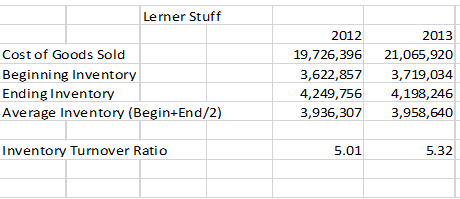
The ratio is only difficult to calculate if a business’s inventory varies significantly throughout the year. Inventory Turnover is calculated as Cost of Goods Sold divided by Average Inventory. The Cost of Goods Sold is always calculated for the Income Statement, so the figure is readily available. Average Inventory may be trickier. For businesses with fairly constant inventory levels, simply add Beginning Inventory to Ending Inventory and divide by two to calculate a simple average.

This simple average doesn’t always work well, however, because many businesses have significantly less inventory at the beginning and end of the year than at other times. The simple average, therefore, uses an artificially low denominator, which tends to overstate the Inventory Turnover Ratio.  So, if monthly inventory figures are available to calculate the average their use will provide a truer Inventory Turnover Ratio:

Using information from the table above, we can calculate Lerner’s Inventory Turnover Ratio for 2012 and 2013. The ratio is determined by dividing Cost of Goods Sold by Average Inventory for each year. For 2012, the calculation is 19,726,396/3,936,307=5.01. For both 2012 and 2013, Lerner turned over its inventory slightly more than five times per year. Bankers interested in Lerner’s Inventory Turnover Ratio would likely compare the Lerner ratio against those of other companies in the same industry. A turnover ratio significantly below those of Lerner’s peer group might cause bankers concern about inventory obsolescence.

Let us know if you would like to see how your ratio stacks up against those of your peers, or to discuss how to improve your ratio.

Filed Under: Business Growth, Business Planning, Cash Flow Planning, Financial Modeling, Key Performance Indicators, Numbers Coach TIPS, Rolling Financial Forecast, Working Capital Tagged With: cash flow forecast, cash forecasting, cash planning, financial metrics, inventory management, inventory turnover, key performance indicators, KPI, preserving cash, working capital management

Your Best Tool for Understanding Short-Term Cash Flow

September 17, 2020 by greenmellen

In a recent article, I shared ideas on how to positively position your company’s financials, even during a slowing economy.  The key is to ensure you have strong cash stores and credit availability.

Today, I will explain a management tool that helps you anticipate your near-future cash flow and identify any areas of weakness: Presenting the 13-Week Cash Flow Analysis. 

You may already use software that allows you to run regular cash flow analyses. These give a more accurate picture than net profit or bank statements.

Initiate your 13-week cash flow analysis by gathering the data needed to build an accurate report:

  • Current bank account and credit card balances
  • Upcoming mortgage or lease payments
  • Estimated cash receipts
  • Estimated payroll and taxes
  • Estimated operating expenses
  • Any other upcoming transactions that will impact cash flow.

The integrity of the report is dependent on the accuracy of the data as well as it being correctly entered or integrated into a spreadsheet or software. For the variable revenue and expenses you estimate, be sure to keep seasonal influences in mind. And remember, you only need to record and predict 13 weeks out – it’s a short-term tool.

A report with solid data and estimates is a good indication of your cash situation over the next 3 months (or, one full quarter). But check the output against your gut:  If the balance seems overly positive in any or all of the 13 weeks, review your estimates, especially sales and accounts receivable forecasts. Being overly optimistic won’t serve you well – if anything, conservative estimates will give you the padding needed to accommodate unpredictable changes.  If you have the time, run worst-, best- and average-case scenarios.

If the report indicates that your company will be cash poor at points during the next 13 weeks, it’s time to review your options:

  • Do you have unneeded equipment or inventory that can be sold to improve fluidity?
  • Are there expenses that can be eliminated, contracts that can be renegotiated or even dissolved, or payments negotiated or delayed?
  • Is it time to implement a collections push?
  • Is your billing and collections process quick and accurate?
  • Are there any loans available to the business?

Once it is set up, maintaining cash flow history and projections is easy. Monitor and update the report weekly, and review your historical projections against actuals to improve your modeling accuracy.

Cash and cash flow are critical to successful operations, and utilizing 13-week cash flow analyses will help you identify gaps and become better at anticipating your future cash needs to keep your business steady. So make proactive cash flow analysis one part of your flexible, resilient business, whether the economy and your customer demand are swinging up, down, or somewhere in between.

Filed Under: Blog, Business Growth, Business Planning, Cash Flow Forecasting, Cash Flow Planning, Financial Modeling, Rolling Cash Flow Forecast, Rolling Financial Forecast, Working Capital Tagged With: business cash flow, cash flow, cash flow forecast, cash forecasting, cash planning, preserving business cash, preserving cash, uncertain cash flow

Preserving Cash in Uncertain Times

April 13, 2020 by greenmellen

I’ve been watching the news and talking with colleagues and clients and wanted to share some strategies with you for preserving cash in the short term that may come in handy in the long term. Here are 12 strategies I recommend:

  1. Research refinance options for any high interest loans and ask for some or all of the closing costs to be waived.
  2. The Small Business Administration has created a program to fast track low interest loans under its Economic Injury Disaster Loan, visit: www.sba.gov/disaster
  3. Reach out to your lenders about deferring payments, or reducing to interest only payments, on debt.
  4. Ask your landlord if you can pay rent at the end of the month (in arrears) for the next 90 days.
  5. Ask your landlord about reducing or deferring Common Area Maintenance (CAM) charges for the next 90 days.
  6. Call clients to see who can pay faster/earlier.
  7. Call vendors to see if you can get extended terms or defer some portion of invoices to a later date.
  8. Ask vendors to take payment on a company credit card. Ask the vendor to charge the amount just after the credit card statement drop date. This can defer a payment from 15-45 days if timed correctly.
  9. Reach out to your credit card company to ask for reduced or zero interest for the next 90-120 days.
  10. Bill customers as quickly as possible.
  11. Consider whether you have any customers who might pay now for future delivery of services.
  12. Defer your personal tax return filing and payment to July 15th. The IRS issued a recent ruling that is allowing a delayed 2019 tax filing until this date. However, if you are owed a refund, file your return now to get the funds.

Congress is in the process of an enacting special legislation to provide relief for businesses and individuals called the “CARES Act” which is in the Senate at this time. Click on this link for a summary of some items in the Act.

If you think of other ideas, I’d love to hear them! My belief is that we will come out of this stronger and definitely together. Scientists around the world will find the path through for our collective well-being.

Stay well! And if you have any questions, concerns or just want someone to talk through your ideas, don’t hesitate to reach out.

Filed Under: Cash Flow Forecasting, Cash Flow Planning, Financial Metrics, Financial Modeling, Key Performance Indicators, Numbers Coach TIPS Tagged With: business cash flow, cash conservation, cash flow forecast, cash planning, preserving cash, uncertain cash flow

Numbers Navigator Helps Pool Company Float More Cash to the Bottom Line

November 3, 2017 by greenmellen

About the Company

Bill White built Southern Splash Pools (“SSP”) in 2001 to provide northern Georgia with quality custom and new pool construction, pool repair and maintenance services.  SSP provides a lifetime structural guarantee with all of its installations.

The Situation

Over the years, Bill realized that his profits weren’t where he thought they should be, but couldn’t identify exactly why:  “At the end of the day, our overall sales numbers were good, but the bottom line was not.”

The Solution

Intrigued by information about the Numbers NavigatorR he found in the Numbers Coach (“NC”) monthly newsletter, White decided to “pull the trigger” and contacted NC’s, Mike Iverson, to provide a comprehensive analysis of SSP’s financial operations.  Iverson used the Numbers NavigatorR to determine the key financial drivers in SSP’s business model, then conducted a discovery session with management to gain an understanding of their key business issues.

NC provided SSP with a comprehensive financial report that identified opportunities to drive more cash flow from the business.  Together the Numbers Coach and SSP determined that margins were too thin, and that pricing per project needed to be adjusted to reach the profitability desired by SSP.  To achieve this the Numbers Coach provided:

  •  A 20+ page financial report detailing key drivers in SSP’s business model
  • Cash on hand/revenue targets for each month
  • Models for various pricing strategies and guidance on creating the pricing structure that would provide more profitability
  • Provided a short-term planning tool to ensure resources and cash were allocated appropriately
  • Established a schedule for accountability check-ins to measure progress on financial goals


“I appreciate Mike’s approach, which is educational and ‘real world;’ he boils it down to
what I really need to know to run my business. The best part is that I now understand
what the numbers are telling me and I have someone besides myself to hold me
accountable for reaching my financial goals.”


Bill White, President, Southern Splash Pools

Filed Under: Business Growth, Business Planning, Case Study, Cash Flow Forecasting, Cash Flow Planning, Financial Metrics, Financial Modeling, Financing a Business, Rolling Financial Forecast Tagged With: business cash flow, business financial planning, cash flow, cash flow forecast, cash forecasting, cash planning, financial education, financial management, preserving cash

Could Cash Flow Be the Problem?

November 3, 2015 by greenmellen

by Collette Parker

Did you know that almost half of businesses have their best-ever year right before they file for bankruptcy? They grow right out of business, and usually it’s not because of lack of sales – it’s poor management of cash.

“They may have had their best year on paper, but when you look at cash flow and working capital’ it’s going south real fast,” says Mike Iverson, CPA, and CEO of Trillium Financial.

The old adage is true: you can’t manage what you don’t measure. And even if sales are good, if you have vendors and employees asking for money, and customers who don’t have to pay for another 45 days – it’s a perfect storm for a cash crisis.

“Take the time to do a financial business plan every year,” Iverson says. Not 30 pages, but a simple two-pager with a financial forecast and a budget for 12 months. “That will give small businesses a leg up from those businesses who don’t write this out.”

Visuals help. It’s not enough to just go through a plan in your head. The process of examining your business closely enough to work out a model and a 12 month plan helps you to understand the flow of your business, including issues of seasonality. If you plan cash flow properly you can figure out how much money you can have in hand when you go into manufacturing season, and how much you’ll make in the selling season. “You can’t just set a $12 million goal, and divide the revenue figures by 12 for the year,” says Iverson.

One financial management tool that is useful in managing cash is a 12-month trailing budget. Once January closes, look at the last 12 months (including January) and chart the revenue. Then look at December and the 12 months prior. Are the numbers higher or lower? Look at the graph. Is it flattening out? Going down? “Graphing a trailing 12 month budget is a simple visual tool,” says Iverson, “and can be used for both sales and expenses.”

“If your management team sees a graph instead of a bunch of numbers, they can understand the concept. Hopefully you’re spotting a positive trend. Either way, you can understand what your cash trends are, and then have a budget that is detailed enough to effectively plan for the year.”

When planning the budget for healthy cash flow, be mindful of how much is invested in your working capital, and keep track of three key areas:

1. Accounts Receivables – Unless you are a cash business, chances are you extend credit to your customers. If your terms are 30 days, your customers should pay you within 30 days, not longer. If you begin to see a trend where customers are waiting 45–60 days to pay, you will probably begin to see cash flow problems. Don’t be a free bank for your customers.

Look at ways to reduce the time it takes customers to pay you: ask for advances from customers, or a down payment, installment, or some level of prepaid portion of the sale. If you’re in the situation where you really need the cash now, you can work with a factoring firm for receivables, or the bank for a loan.

2. Accounts Payable – Have favorable credit terms and solid partnerships with your vendors. In this area, you want to hold on to your money as long as you can. But, if vendors offer early payment discounts and you can afford to take it, go ahead. Sometimes, even if you have to borrow the money to pay early, it might make sense to do so. If you can borrow money at eight percent and take a two percent discount for 10 days early (2% 10 net 30) you are effectively earning 36 percent over a year. (If you do that, make sure the borrowing doesn’t put you at risk for running out of cash and not being able to pay your other bills.)

3. Inventory – Manage your inventory so that it doesn’t sit in a warehouse for too long. Once you’ve paid for the inventory, it should be sold and generate profit for you. Adjust your inventory for the seasonality of your industry so you’re never caught with too much.

An example of good management of these three factors would be to extend 30 day terms to customers, purchase inventory and turn it around in 15 days; and pay vendors in 30 days.

Financial planning doesn’t have to be complicated to be effective. Measuring the past 12 months of working capital performance, income statement performance, sales growth and profit, will give you a really good picture of your business and let you prepare for future sustainable growth.

Filed Under: Blog, Business Growth, Cash Flow Forecasting, Cash Flow Planning, Financial Metrics, Financial Modeling, Key Performance Indicators, Rolling Cash Flow Forecast, Rolling Financial Forecast, Working Capital Tagged With: business cash flow, business financial planning, business planning, cash flow, cash flow forecast, cash forecasting, cash planning, financial metrics, key performance indicators, metrics, preserving business cash, preserving cash

Cash Reserves Help Your Business Weather the Storm

November 3, 2015 by greenmellen

by Michael Iverson

“Save it for a rainy day” is an old saying that still makes sense today. In good times, it’s smart to put aside something for the lean times that are sure to follow.

For a business owner, saving for a rainy day means building cash reserves. Liquidity is the lifeblood of any business, and a lack of liquidity is the cause of most business failures. Squirreling away cash during times of prosperity may, one day, save your business.

A cash reserve provides a business owner with the financial flexibility to continue operations during difficult times. In a sluggish economy, for example, a business may receive less cash from operations than anticipated. Customers who lose jobs are unable to pay their accounts on time. As a result, the business owner finds there’s simply not enough cash coming in to meet business expenses.

The owner can’t very well tell employees and vendors that they won’t be paid until customers pay their accounts, or he risks driving them away. A wise business owner wants to keep his employees and vendors happy, so he pays them on time. He usually does so by tapping into the cash reserve he established during good times.

Cash Reserve vs. Line of Credit

Business owners that have the foresight to build generous cash reserves are sometimes reluctant to tap those reserves. When difficult financial times arrive, a business owner shouldn’t feel any guilt about putting those reserves to use. The funds were saved with a specific purpose in mind—one day the business might not be able to generate adequate cash from operations.

When that day arrives, the question to ask is whether it’s best to dip into the cash reserve fund or make use of an available credit line. Usually, the conservative stance that led the owner to build cash reserves prevents him from taking on debt. But, there are circumstances when using the credit line makes sense. We recommend that you pose the question to your financial advisor.

When it’s considered best to use the cash reserve fund, the money will be put to good use. It will pay the salaries of your employees that have helped you achieve so much over the years. Hopefully, they will continue to be productive employees for years to come. This is a time for looking ahead. Make it a celebration of good business planning and loyal employees.

Opportunity Knocks

Cash reserves may also provide unexpected opportunities. Suppose a competitor of yours is highly leveraged. He has grown his business using borrowed money. He didn’t anticipate an economic downturn and never gave much thought to putting aside cash for a rainy day. What happens if his customers can’t pay their bills in a timely manner? He will have a tough time making payments on his business loans. If the problem is serious enough, he might be forced to liquidate the business. His customers could easily become new customers of yours. His employees might become your employees.

Not sure how to reserve some cash every month?  Contact Michael for advice on how to modify your current business financial model to weather future storms.

Filed Under: Blog, Business Growth, Business Planning, Cash Flow Forecasting, Cash Flow Planning, Employer Tips, Financial Modeling, Key Performance Indicators, Rolling Cash Flow Forecast, Rolling Financial Forecast, Working Capital Tagged With: cash conservation, cash flow, cash flow forecast, cash forecasting, financial leadership, preserving cash, successful characteristics, uncertain cash flow, working capital management

NumbersCoach_Logo_green-gray_stacked

Proud Supporter of

Screenshot 2025-09-09 150120

Get Financial Tips Delivered To Your Inbox

Protect your business' financial health with our monthly financial tips.

Contact Info

P.O. BOX 250
Decatur, GA 30031

404-353-2148

info@numberscoach.net

© 2026 Trillium Financial, Inc
Privacy Policy | Accessibility | Terms