
NumbersCoach_Logo_Endorsed_UnderLogotype_2
  • Numbers Coaching
    • The Numbers Navigator®
    • Case Studies
  • About
    • Trillium-Numbers Coach Story
  • Resources
    • Blog
    • Numbers Coach TIPS
    • Podcasts
    • Numbers Coach Tools
  • Numbers Coach University
  • Contact
  • Search

How to Spot These 6 Financial Warning Signs and What They Mean

March 4, 2026 by greenmellen

If you read the headlines of national and local news, it is amazing that so many businesses are seemingly strong one day, and the next they are closing or filing for bankruptcy.

One of the many reasons this happens is that business owners and managers don’t pay attention (or don’t want to acknowledge) the financial warning signs that could have saved them. By the time the financial collapse starts, it’s often too late to change course.

6 Warning Signs You Can Look For

To help you spot these warning signs, here are the 6 financial red flags that we coach our clients to take action against:

  1. [The Most Telling Sign] Cash Holdings and Equity Are Lower Compared to the Previous Periods
    Take a look at your balance sheet and income statement to determine your overall cash holdings and equity (Assets-Liabilities). If your liabilities are higher, ask why.  Negotiate terms to lower credit rates, extend payment terms, etc. Involve other departments to determine how your business can operate more efficiently and cost-effectively. Discuss simple ways to increase revenue without significantly increasing overhead.
  2. Days in Accounts Receivable Increasing
    Many customers are pushing the envelope with their payment terms. Create a process for collecting outstanding receivables, and ratchet it up when customers start paying late. Customers often pay those vendors with strong systems, and delay payment to those suppliers who don’t have solid collections practices. This doesn’t mean that you won’t work with a long-standing customer who asks you for some flexibility. It does mean that you implement smart AR strategies such as late payment fees, outsourced collections help and credit reporting with clear communication and consistency.
  3. Not Enough Cash Flow for Accounts Payable
    Order in smaller quantities of goods/services from your suppliers. Talk to vendors to negotiate extended terms, leveraging your long-standing relationship and good business practices.  Use a credit card with 60-day terms to maximize the number of days to pay (make sure to review your credit card agreement and understand the terms). Search for discounts for paying within terms if your suppliers won’t stretch the terms. These strategies may not impact your cash flow immediately, but they can have an overall impact by improving your bottom line, since you are buying product or services at a lower price. Get a good handle on your inventory, turn rate, spoilage, sales trends, etc. so you actually buy smarter.
  4. Evaluate Profit Margins and Turnover Ratios
    We all know that decreasing profit margins are a bad sign, but they can’t be evaluated alone. Turnover ratios are also an important factor. Remember, mega grocery stores and warehouse clubs have low profit margins, but high turnover ratios that result in adequate net income and, more importantly, reasonable cash flow. The key is to look at both your profit margins and turnover rates together because how they interact will ultimately tell you how much cash has flowed into your bank account.
  5. Indirect Overhead Growing with Increase in Sales
    Take a hard look at operations. Are you running as efficiently as you could be? Are your employees productive or can they take on more responsibilities? There are more costs to adding employees than just salary, benefits and taxes. You have equipment, space, recruiting/training time, etc. for each employee you hire. The goal is to increase sales without increasing your fixed overhead. If you find there is nothing you can do to avoid increasing your fixed costs, you might need to re-evaluate your business strategy to determine how you can raise your profit margins to accommodate for your increase.
  6. Warning Signs Outside Your Business
    Every business should use and review a weekly dashboard that includes many of the warning sign financial metrics listed above: gross profit margin, average daily outstanding AR, inventory turns, days payable outstanding, available line of credit, operating profit margin, etc.  But ultimately, there are other warning signs that may not be on your dashboard.   Below is a story from a business who engaged a trusted advisor for an outside perspective.

 A Real-World Example of Heeding the Warning Signs

“Most people under-emphasize the available line of credit,” says Joe Dresnok, a consultant with Management Horizons. “The perfect storm for a company is a down economy, reduced sales and the inability to reduce overhead. When this happens, a company needs to access their credit lines to get through the tough times, and invest in other avenues to generate revenue.”

But during a slow economy, banks will reduce credit lines. One of Joe’s clients had a $300,000 line of credit, of which they had drawn down 1/3.  Joe and his team recommended the client draw down the rest of the credit line. Within 30 days, the bank came to give the “bad news” that they were reducing the company’s credit line to $100,000. The company was happy to report they had already tapped out all $300,000 of the original credit line. “In essence, they preserved $200,000, which translated to staying power.”  In this case, it was definitely worth the cost of that credit to preserve the line.

Each company has its own specific set of measurements (metrics) to help owners understand what to look out for in their financials. (Here are the 8 essential financial metrics we recommend tracking.)  This will at least give you the chance to prevent your company from embodying a quote from Ernest Hemingway:  When asked how one goes bankrupt, he said “Two ways:  Gradually, and then suddenly.”

Watch for the warning signs!

Filed Under: Blog, Financial Metrics, Financial Modeling, Financial Tools, Key Performance Indicators, Numbers Coaching, Own Your Numbers Tagged With: business financial planning, financial analysis, financial dashboard, financial metrics, financial reporting, key performance indicators, KPI, metrics

What’s the Key Number You Rely On Daily?

November 12, 2025 by greenmellen

by Bernadette Peters

Key performance indicators can tell us how well we are doing in our businesses.  But sometimes waiting for accounting software data entry and reporting can be too late for us to make important adjustments quickly.

Many businesses rely on key numbers they can access quickly each day to give them an idea of how they are really doing financially. It can take some time to figure out what that metric is, however, once you do, you are much more prepared to make smart business decisions on the fly.

Coffee Shop Looks at 3 Sales Categories

A young coffee shop and wine bar owner was tracking daily revenues to determine the appropriate number of staff to schedule on a shift.  An early mistake they made was to staff only on the basis of revenue. They later learned that transactions were much smaller and the volume was much higher in the mornings, requiring more staff. And although revenues were much stronger in the evening, higher transactions and retail wine sales required less manpower. Now they look at three distinct categories of sales: coffee drinks, retail wine and enter orders. They can get this information at any time through their point of sale system, which is updated instantly as transactions occur.

Management is able to understand peak volume times and days by looking at this data over an extended period of time. From this information they can understand how to better staff their operation to ensure high-quality customer service experience.

Strategy Consulting Firm Drills Deeper

A typical strategy consulting firm would normally review income and expenses after services have been completed and billed.  However, one firm in particular reviews several other numbers to determine how well they are doing and what adjustments to make along the way.

Jeff Pruett, CFO at ATPAC Group, previously worked as the CFO of a marketing strategy consulting company.  He indicated that his former consulting company looked not only at revenue per consultant, but they also determined how to maximize a consultant’s 40-hour work week via revenue per full-time equivalent employee company wide. This allowed management to determine the ideal work force size. 

Jeff also reviewed how much of the consulting pool’s time was spent on billable and productive activities as opposed to “bench” time to understand how consultants are utilized and billed. He also reviewed project contribution margins as part of ongoing analysis of an in-process job to see if the job is getting in to trouble prior to its delivery and whether it’s losing margin.

What are Your Key Daily Numbers?

What are the key daily numbers that are essential to making decisions about your business on the fly?Determining what these numbers are in your particular business might require some help from a professional, but once you do, your management team can be much better prepared to make smart proactive business decisions. It may require measuring numerous metrics for a period of time, sometimes even two years or more, before you can figure out which metric or group of metrics are truly predictive for your business.

Need some guidance in determining these metrics? The Numbers Coach is here to help. Contact us today for a complementary review session of your numbers.

Filed Under: Blog, Business Growth, Financial Metrics, Key Performance Indicators, Numbers Coaching, Own Your Numbers Tagged With: financial metrics, key performance indicators, KPI, metrics

Do You Know What This Financial Warning Sign Could Mean For Your Business?

September 20, 2025 by greenmellen

Owners are often so immersed in the day-to-day details of their businesses that they can’t always see financial warning signs of tough times ahead. If you can’t see the warning signs, you can’t avoid the danger.

At the Numbers Coach, we teach business owners how to spot the warning signs. We closely monitor revenues, receivables and cash flows. These three figures are closely related. Businesses often struggle because of poor cash flow, which usually indicates declining revenues and/or slow collection of business receivables.

12/12 Rate of Change

One of my favorite tools to spot early financial warning signs of potential trouble is a chart called the 12/12 rate of change. During difficult economic conditions, I watch this rate of change closely. If I start to see it slip from 20 percent to 19 or 18 percent, we need to investigate why. If a business continues down that path for too long, the impact will be quite negative.

Let’s take revenues as a simple example. Each month, we calculate total revenues for the past 12 months and we compare it against the same figure for the prior year. Then, we calculate the rate of change from last year to this year. If last year’s 12-month revenue figure is $1 million and this year’s 12-month revenue figure is $1.2 million, we have a 20 percent rate of change. Perhaps you can’t change the revenue figure during tough times, because customers postpone the purchase of your product or service. In that event, it may be possible to lower your expenses and avoid losing money.

The 12/12 rate of change provides a long-term view of your business. It is very useful for spotting changes in a business trend, positive or negative, that have occurred during the past year.

12/12 Rate of Change for Fixed Overhead

To take the analysis a step further, I like to review the 12/12 rate of change for the fixed overhead of a business. It tends to be a leading indicator of future bottom-line results when combined with the 12/12 rate of change for revenues.

Fixed costs are those incurred whether you generate any revenue or not. They include rent and, for many service businesses, staff salaries and benefits.

Let’s imagine a business has a 12/12 rate of change for revenues that shows 5 percent growth. If the 12/12 rate of change for fixed overhead shows 10 percent growth, the business has a problem to address. The business is adding to its fixed overhead at a rate that exceeds top-line revenue growth. That’s a financial warning sign. Because of the long-term nature of the 12/12 rate of change, there is no need for immediate panic. However, if the situation is not remedied, it will pose a threat to the future health of the business.

To investigate further, I look at the trailing 12 months of revenues and fixed overhead expenses – not the rate of change, just gross dollar amounts. Is the revenue increasing or decreasing? We plot points on a graph to develop a clear trend line. We do the same for fixed overhead expenses. If, earlier in the year, you noticed an unhealthy rate of change trend and took corrective action, you can check your progress by reviewing the trailing 12. Using both metrics gives you a better read of the situation you face today.

What type of corrective action can you take? There are several possibilities, including increasing your sales, speeding up your collection cycle, or cutting expenses.  If you are not sure which path is best for your business, contact us for a free consultation.

Filed Under: Cash Flow Planning, Financial Metrics, Key Performance Indicators, Numbers Coach TIPS, Own Your Numbers Tagged With: business financial planning, financial analysis, financial education, financial leadership, financial management, financial metrics, key performance indicators

Thermal Support Finds Financial Support with the Numbers Coach

February 20, 2025 by Mike Iverson

The Company

Thermal Support (“TS”) is an international source for thermal analysis consumable products started and nurtured by Charles Beine.  TS provides a full range of thermal analysis DSC sample pans and TGA and TG/DTA sample pans. The company’s high-quality aluminum and ceramic pans are the standard as a non-OEM supplier.  TS serves a wide geographic area nationally and internationally, including labs and university research centers.  TS has been providing its high-quality products and support services for over 20 years. 

Situation

In 2024 the TS team wanted to enhance their understanding of their financial results.  They wanted to use a platform that communicated the company’s key performance indicators (“KPIs”) and educate its leadership team members on what drives the company’s financial results.  The TS team was missing a game plan that could guide them to make better financial decisions. Enter Numbers Coach Mike Iverson.

Solution: The Numbers Coach Financial Leadership Services

The Numbers Coach (“NC”) financial leadership services were an ideal fit for TS.  Using NC’s proprietary Numbers NavigatorTM financial platform, a financial scorecard is used to focus on measurements that drive company profits and cash flow critical to sustaining a business.  The scorecard offers the TS team an “at a glance” view of results.  The Number Navigator’sTM rolling financial forecast gives the TS team a tool to make critical decisions and see where they are headed financially. 

Results

NC pulled together financial and non-financial data to complete a scorecard, financial model, and supplemental reporting.  Each quarter NC meets with the TS team to methodically review results and provide input and analysis from the Numbers NavigatorTM.  From each Numbers Coach financial meeting, the TS team can take actions on activities that improve the company’s bottom line results.  Beine and his team can access the Numbers NavigatorTM at any time due to its cloud-based delivery platform.

“Mike’s approach to coaching us on how to drive our financial results gives our team the right tools to help understand how to navigate our finances successfully and stay focused on our cash flow and investment goals.” 

Charles Beine, Founder & CEO

For more information on Thermal Support visit www.thermalsupport.com

To learn more about the Numbers Coach financial leadership services, click here

Filed Under: Case Study, Financial Modeling, Financial Reporting, Key Performance Indicators Tagged With: business financial planning, financial metrics, financial scorecard, key performance indicators

Do You Have A Red Flag In Your Business?

April 26, 2023 by Mike Iverson

Small emerging growth companies often have limited resources and limited staff performing critical functions in accounting/finance.  Below is a list of tips that might indicate a closer look at your records for accuracy or the opportunity for fraud.

  • A spike in payroll expense without a reasonable explanation
  • Accounts receivable is growing but your sales are flat or down
  • Vendors who are being paid but you are not familiar with them
  • Human Resource records are minimal or non-existent for employee pay changes
  • Expense actual vs. budget shows a variance that is not reasonably explained
  • Prepaid expenses are growing consistently month to month but most expenses are flat or down in your income statement

I read an article recently where the same accountant who posted and deposited customer receipts had embezzled $126,000.  How?

The employee deposited customer checks to their ATM which is not always checked thoroughly the banking system.  The accountant then marked the corresponding invoice as “paid” and used the subsequent checks that came in for newer invoices.  This process could only go on for so long because the accounts receivable would grow from a larger pool of unpaid invoices.  Just as the accountant was about to leave the job, the embezzlement was discovered.

It was discovered by auditors checking on the cycle of a paid invoice; from receipt of check, to posting payment to the invoice, to depositing the check at the bank.  Some invoices shown as “paid” did not have a corresponding deposit.  Getting a copy of the deposited check from the customer revealed a different account number from the company’s account and discovered it was a personal account of the employee.

Here’s to a system of processes and activities that represents the phrase “trust but verify” to help you mitigate any circumstances where the health of your business is compromised!

Mike

Filed Under: Business Growth, Business Planning, Cash Flow Planning, Financial Metrics, Financial Modeling, Key Performance Indicators, Numbers Coach TIPS Tagged With: business financial planning, financial dashboard, financial education, financial metrics, financial reporting, key performance indicators, KPI

Want More Cash Flow? Check your Accounts Receivable Cycle

April 13, 2023 by Mike Iverson

I sometimes hear from business owners that they are making a profit, but they don’t seem to have positive cash flow at the end of the year. What happened?

Your business may generate a positive net income, but if you aren’t monitoring other key cash flow drivers, then you can find yourself strapped for cash to meet the obligations of the business.

One of those drivers that can cause a lack of cash is your Accounts Receivable (A/R) collection cycle. It’s one of the four pillars that drive cash flow (along with Accounts Payable, EBITDA, and Inventory Days-on-Hand)

Your Accounts Receivable Cycle

Many businesses offer customers the ability to “Buy Now, Pay Later” for their purchases. In other words, they are providing customers a short-term interest free loan to pay for the product or service! If your customer doesn’t pay on time or takes longer than you expect, it can create a cash flow problem in your business.

Monitoring how long it takes for you to collect your accounts receivable is important. The quicker you can collect it, the quicker you get the cash you need to pay your bills and reinvest for your company’s growth.

But how do you measure it? Below is a formula to determine your collection cycle. Keep in mind your cycle will shift weekly, monthly, quarterly, etc… The calculation is merely a “snapshot in time,” but it’s important to know.

Formula:
Annual sales / 365 days= daily sales
Accounts receivable balance / daily sales= days to collect accounts receivable

Example:
$1,000,000 / 365 days= $2,740 daily sales
Accounts receivable $80,000 / $2,740= 29 days

In the above example, it takes on average about 30 days to collect the amounts owed by the company’s customers. If this metric increases from 29 days to 39 days, then the extra 10 days has left the company with $27,400 less cash in their bank account than if they had collected it in 30 days. This is where the business owner could see a positive net profit in the profit and loss statement, but also see that their cash balance has decreased by $27,400.

Know your accounts receivable collection cycle. Calculate it on a regular basis, such as monthly. Identify customers who are consistently not paying on time and determine a strategy to encourage them to pay within the terms you have offered. It can be the difference between positive or negative cash flow!

For more resources to help you measure this important metric, check out our Numbers Coach tools and templates.

Filed Under: Cash Flow Planning, Financial Metrics, Key Performance Indicators, Numbers Coach TIPS Tagged With: accounts receivable management, business cash flow, cash conservation, cash flow forecast, cash forecasting, cash planning, collection pattern, collection tips, key performance indicators, preserving cash, uncertain cash flow, working capital management

Measuring Your Performance

February 27, 2023 by Mike Iverson

One of the quotes that keeps coming back to me is “What gets measured gets done.” This simple mantra has held true for me both professionally and personally.  I sat down the other day to look at a set of goals that I had set 5 years ago.  I actually had forgotten about the document until I ran across it while cleaning out paperwork to start my new year.

It is amazing to see the power of writing down the goals and how they actually came true.  Not all of mine happened, but a good chunk of them did.  

Here were my goals:  

  • Take a family trip to Europe.  Checked that one off despite having three teenage girls going in multiple directions with their activities.   
  •  Expand our current home or find one more suitable. . . four years later, a more suitable house became available.
  • Be a part of a charitable foundation that gave back into my community…done, I began serving on the board of New American Pathways three years later.

For me the quote “from lips to pencil tips” says it all.  Once I write down the goal and use the SMART principles…accomplishment is not too far away.  SMART goals are: 

  • Specific
  • Measurable
  • Actionable
  • Realistic
  • Time bound

What are your goals?  Have you written them down?  Can you measure them? 

My challenge to you is to write down up to three goals you want to accomplish over 1, 2 or 3 years.  Check on them every so often, and then 4 or 5 years later you will see the power of performance measurement.

Here’s to achieving SMART goals!  

Mike

Filed Under: Key Performance Indicators, Leadership, Numbers Coach TIPS, Productivity Management Tagged With: financial dashboard, financial management, financial metrics, financial reporting, key performance indicators

What Your Inventory Turnover Ratio Is Telling You

May 6, 2022 by greenmellen

Bankers who lend to small businesses in manufacturing and distribution often calculate a client’s inventory turnover ratio. “What are the bankers looking for in a ratio?” clients sometimes ask.

First, bankers wonder whether the business is carrying inventory that is disproportionate to its sales. Carrying excess inventory is not a productive use of capital when money is tied up in product that sits on a shelf and incurs warehouse costs.

A second concern for lenders is that inventory not turned over quickly will become obsolete, damaged, or outdated. In any of those circumstances, revaluation of the inventory is necessary and losses must be booked. That’s a concern to lenders.   Also a decreasing turnover rate could indicate a slowing sales and lower profit trend.

Calculating the Ratio

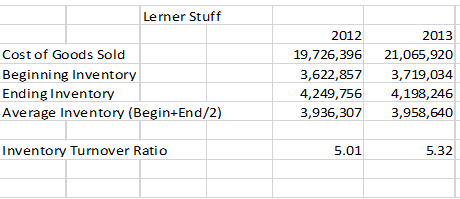
The ratio is only difficult to calculate if a business’s inventory varies significantly throughout the year. Inventory Turnover is calculated as Cost of Goods Sold divided by Average Inventory. The Cost of Goods Sold is always calculated for the Income Statement, so the figure is readily available. Average Inventory may be trickier. For businesses with fairly constant inventory levels, simply add Beginning Inventory to Ending Inventory and divide by two to calculate a simple average.

This simple average doesn’t always work well, however, because many businesses have significantly less inventory at the beginning and end of the year than at other times. The simple average, therefore, uses an artificially low denominator, which tends to overstate the Inventory Turnover Ratio.  So, if monthly inventory figures are available to calculate the average their use will provide a truer Inventory Turnover Ratio:

Using information from the table above, we can calculate Lerner’s Inventory Turnover Ratio for 2012 and 2013. The ratio is determined by dividing Cost of Goods Sold by Average Inventory for each year. For 2012, the calculation is 19,726,396/3,936,307=5.01. For both 2012 and 2013, Lerner turned over its inventory slightly more than five times per year. Bankers interested in Lerner’s Inventory Turnover Ratio would likely compare the Lerner ratio against those of other companies in the same industry. A turnover ratio significantly below those of Lerner’s peer group might cause bankers concern about inventory obsolescence.

Let us know if you would like to see how your ratio stacks up against those of your peers, or to discuss how to improve your ratio.

Filed Under: Business Growth, Business Planning, Cash Flow Planning, Financial Modeling, Key Performance Indicators, Numbers Coach TIPS, Rolling Financial Forecast, Working Capital Tagged With: cash flow forecast, cash forecasting, cash planning, financial metrics, inventory management, inventory turnover, key performance indicators, KPI, preserving cash, working capital management

The Numbers Coach Builds Financial Blueprint for Sustainability Company to Grow

October 28, 2021 by greenmellen

The Company

Sustainable Investment Group (“SIG”), founded by Charlie Cichetti and Jason Kiefer, provides sustainability services to commercial property owners. SIG provides high quality services for LEED certification with commercial buildings. A LEED certified building ensures the property uses sustainable activities to help protect our environment. SIG offers LEED training, consulting, and engineering services domestically and internationally. SIG has become an industry leader and expert in LEED practices.

Situation

In 2020 the SIG team wanted to enhance their financial management and reporting. They were looking to create a platform to communicate the company’s key performance indicators (“KPIs”) that drive its financial results. In addition, the SIG team wanted a “road map” that could guide them as they made financial decisions impacting strategies for growth.

Solution:  Numbers Coach Leadership and Numbers Navigator Services

The Numbers Coach‘s financial leadership services, led by Mike Iverson, were an ideal fit for developing SIG’s performance metrics. Iverson developed a financial scorecard focusing financial drivers that give the team visibility into the profits and cash flow critical to sustained profitable growth. The scorecard offers an “at a glance” view of results. Using our proprietary software (the Numbers NavigatorR), the Numbers Coach plan provided the road map for the SIG team to see where they were headed with profits and cash flow. The model provides a rolling forecast during the year so that the SIG team could make financial and operational decisions “on the go” to achieve their goals.

Results

Iverson pulled together financial and non-financial data to complete a customized scorecard and financial model. Each month, the Numbers Coach meets with the SIG team to methodically review results and provide the input and analysis from the Numbers NavigatorR software. From the monthly financial coaching meetings, the SIG team can take actions on activities that improve the company’s bottom line results.

For more information on Sustainable Investment Group visit www.sigearth.com

To learn more about Numbers Coach services, click here

“Mike has been an important part of our team.  His understanding of financial processes, cash flow, and how to explain our results gives our team the right tools to navigate our finances successfully and stay focused on our financial goals.”  

– CHARLIE CICHETTI

Filed Under: Business Growth, Business Planning, Case Study, Financial Metrics, Financial Reporting, Key Performance Indicators Tagged With: blueprint, financial management, financial metrics, financial reporting, key performance indicators, KPI, numbers coach

Numbers Coach Eases the Pain of Financial Management for Medical Practice

March 23, 2021 by greenmellen

The Company

Pain Care, LLC (formerly Georgia Pain and Spine Care) is a leading pain management medical services firm that provides comprehensive solutions to help restore each patient to their original lifestyle. The company uses progressive approaches to pain management with education, counseling, and minimally invasive procedures. Their mission is to relieve pain, increase productivity, and improve the quality of life for its patients using technologically advanced treatment regimens through its various metro Atlanta offices.

Situation

In 2020, the Pain Care team wanted to enhance their financial management and reporting capabilities. They wanted to create a platform to communicate the company’s key performance indicators (“KPI”) and help educate its key team members on what drives its company’s financial results. In addition, the Pain Care team wanted a “road map” that could guide them as they made financial decisions impacting strategies for growth.

Solution:  Numbers Coach Leadership and Numbers Navigator™ Services

The Numbers Coach (“NC”) financial leadership services were an ideal fit for developing Pain Care’s performance metrics. NC developed a financial scorecard to focus on the financial measurements that drive company profits and cash flow critical to sustained profitable growth. The scorecard offers an “at a glance” view of results. NC developed a financial model from its proprietary software, the Numbers Navigator™ . The software provides a road map for the Pain Care team to see where they are headed with profits and cash flow. The software’s rolling financial forecast provides the Pain Care team with a tool to make critical decisions “on the go” to achieve their desired results.

Results

NC pulled together financial and non-financial data to complete a scorecard and financial model. Each month NC meets with the Pain Care team to methodically review results and provide the input and analysis from NC’s Numbers Navigator™ financial software. From the monthly financial coaching meetings, the Pain Care team can take actions on activities that improve the company’s bottom line results.

For more information on Pain Care, LLC visit www.georgiapaincare.com

To learn more about the Numbers Coach financial leadership services, click here

“Mike has become an important part of our team.  His understanding of financial processes, cash flow, and approach to educating us on our results gives our team the right tools to help us understand how to navigate our finances successfully and stay focused on our financial goals.”  

Dr. Charles Brownlow, Founder / Medical Director

Filed Under: Business Growth, Business Planning, Case Study, Cash Flow Planning, Financial Metrics, Financial Modeling, Key Performance Indicators Tagged With: business financial planning, business strategic planning, business strategy, company strategy, financial dashboard, financial education, financial management, financial metrics, key performance indicators, KPI

Keep Your Finger on the Pulse of Your Business

September 11, 2019 by greenmellen

There are plenty of ways to measure the financial success of your business: profit margins and revenue growth, for instance.  But do the old standby measures give you the whole picture? It’s never too early or too late to try out new ways of analyzing the financial health of your business.

I recently came across a 2017 Inc. magazine article written by entrepreneur and author Norm Brodsky. In “Pencil Power” he suggests an assessment method that would have been called “old fashioned” in the past, but today might be termed “retro.”  It involves—brace yourself—a pencil and paper.  (Yep, I’m coming back to the same pencil and paper I mentioned in a blog post a few months ago.)  Brodsky believes that tracking monthly sales and gross margins by hand is especially beneficial to new, or relatively new, business owners.

He says the practice will improve young businesses’ chances of success 100 times over:

“By writing the numbers down and doing the calculations yourself, you begin to have a feel for the relationships between them. Later on, when other people are reporting numbers to you, you’ll be better able to recognize when something’s wrong.”

Brodsky recommends a simple exercise to try at the end of each month: write down sales, cost of goods, gross profit, and gross margin of each product for both the month and year-to-date. Then write down the same information for each customer.  This is a quick way to see where you are saving money and where you aren’t.

If your business is already doing a good job tracking these metrics, there might be others that could shine light on an area that’s erratic or negatively trending. Try writing down monthly inventory holding costs or Accounts Payable and Accounts Receivable totals. Maybe some cash flow metrics need attention.

It’s a painless, 30-minute exercise that just might surprise you by exposing a weak or strong area of your business that’s been hiding in the dark. Add it to your evaluation and decision-making arsenal. I suspect you’ll find it insightful.

Let us know if we can help you track your metrics.

Filed Under: Business Planning, Employer Tips, Financial Metrics, Financial Modeling, Key Performance Indicators, Leadership, Numbers Coach TIPS, Productivity Management Tagged With: business financial planning, financial dashboard, financial education, financial habits, financial leadership, financial management, financial metrics, key performance indicators, KPI

Do You Know Your ROCE?

March 5, 2019 by greenmellen

How Measuring Your Return on Capital Employed is Critical for Financial Health

There are so many ways to measure a company’s financial success: profit margin, return on equity, and return on invested capital.

Return On Capital Employed (ROCE) is a lesser known but equally important financial indicator. ROCE is especially useful for evaluating your company’s macro level financials or other companies to invest in. It’s essential because it goes beyond simple profit margins to specifically assess how well a company runs, conducts its business, and returns value to investors.

ROCE is the total of a firm’s assets and revenues minus current liabilities. The ROCE ratio is simple:

Return on Capital Employed = Earnings Before Interest and Tax (EBIT)/Capital Employed

The higher the result of the formula, the more efficiently a company is utilizing its capital. If a company’s ROCE has gone up since last year or in the last few years, it indicates a company is going in the right direction. At a minimum, ROCE should exceed the cost of capital (financing costs), or the company can find itself in a bad financial state.

ROCE is especially useful in comparing how different companies in the same industry leverage their capital, particularly in capital-intense industries like energy, auto, and telecommunications that habitually hold a large amount of debt.

Don’t confuse ROCE with ROE (return on equity), even though both are profitability ratios that measure a company’s profitability as related to funds invested. ROE takes profits generated from shareholders’ equity into consideration, as opposed to ROCE, which uses all capital employed including the company’s debt.

ROCE percentage is one of the tools for judging the performance of managers and how effectively they are running a business. It’s a good idea to look at the industry average and the ROCE of competing companies.  The ROCE percentage is one of the few metrics that does allow you to compare across industries and within your industry.

If employed capital is not given in financial statement notes, it can be calculated by subtracting current liabilities from total assets. Watch for poor quality profits, such as the sale of expensive equipment that can’t be repeated regularly, as these can create an artificially high ROCE. Other factors such as leasing versus purchasing equipment can also lead to a slightly higher ROCE.

Despite the value of evaluating a company’s ROCE, it should not be the only factor used for an accurate assessment of financial stability; other probability ratios certainly contribute to the whole picture.  However, knowing your ROCE percentage is important metric for a business owner to keep track.  Your ROCE percentage provides the business owner the return they are getting on their investment in the company.

If you want to learn your ROCE percentage, feel free to reach out to Mike to get a free template at Mike@trilliumfinancial.com.

Filed Under: Blog, Business Growth, Business Planning, Cash Flow Planning, Employer Tips, Financial Metrics, Financial Modeling, Key Performance Indicators, Rolling Financial Forecast Tagged With: business financial planning, financial analysis, financial education, financial habits, financial management, financial metrics, financial reporting, key performance indicators, KPI

  • 1
  • 2
  • Next Page »
NumbersCoach_Logo_green-gray_stacked

Proud Supporter of

Screenshot 2025-09-09 150120

Get Financial Tips Delivered To Your Inbox

Protect your business' financial health with our monthly financial tips.

Contact Info

P.O. BOX 250
Decatur, GA 30031

404-353-2148

info@numberscoach.net

© 2026 Trillium Financial, Inc
Privacy Policy | Accessibility | Terms