NumbersCoach_Logo_Endorsed_UnderLogotype_2
  • Numbers Coaching
    • The Numbers Navigator®
    • Case Studies
  • About
    • Trillium-Numbers Coach Story
  • Resources
    • Blog
    • Numbers Coach TIPS
    • Podcasts
    • Numbers Coach Tools
  • Numbers Coach University
  • Contact
  • Search

Want More Cash Flow? Check your Accounts Receivable Cycle

April 13, 2023 by Mike Iverson

I sometimes hear from business owners that they are making a profit, but they don’t seem to have positive cash flow at the end of the year. What happened?

Your business may generate a positive net income, but if you aren’t monitoring other key cash flow drivers, then you can find yourself strapped for cash to meet the obligations of the business.

One of those drivers that can cause a lack of cash is your Accounts Receivable (A/R) collection cycle. It’s one of the four pillars that drive cash flow (along with Accounts Payable, EBITDA, and Inventory Days-on-Hand)

Your Accounts Receivable Cycle

Many businesses offer customers the ability to “Buy Now, Pay Later” for their purchases. In other words, they are providing customers a short-term interest free loan to pay for the product or service! If your customer doesn’t pay on time or takes longer than you expect, it can create a cash flow problem in your business.

Monitoring how long it takes for you to collect your accounts receivable is important. The quicker you can collect it, the quicker you get the cash you need to pay your bills and reinvest for your company’s growth.

But how do you measure it? Below is a formula to determine your collection cycle. Keep in mind your cycle will shift weekly, monthly, quarterly, etc… The calculation is merely a “snapshot in time,” but it’s important to know.

Formula:
Annual sales / 365 days= daily sales
Accounts receivable balance / daily sales= days to collect accounts receivable

Example:
$1,000,000 / 365 days= $2,740 daily sales
Accounts receivable $80,000 / $2,740= 29 days

In the above example, it takes on average about 30 days to collect the amounts owed by the company’s customers. If this metric increases from 29 days to 39 days, then the extra 10 days has left the company with $27,400 less cash in their bank account than if they had collected it in 30 days. This is where the business owner could see a positive net profit in the profit and loss statement, but also see that their cash balance has decreased by $27,400.

Know your accounts receivable collection cycle. Calculate it on a regular basis, such as monthly. Identify customers who are consistently not paying on time and determine a strategy to encourage them to pay within the terms you have offered. It can be the difference between positive or negative cash flow!

For more resources to help you measure this important metric, check out our Numbers Coach tools and templates.
Filed Under: Cash Flow Planning, Financial Metrics, Key Performance Indicators, Numbers Coach TIPS Tagged With: accounts receivable management, business cash flow, cash conservation, cash flow forecast, cash forecasting, cash planning, collection pattern, collection tips, key performance indicators, preserving cash, uncertain cash flow, working capital management

What’s the Deal with Working Capital?

November 3, 2022 by greenmellen

A Unique Look at Asset Based Lending
by Marc Smith

“Cash is King.”  We’ve all heard the expression, but if you haven’t owned your own business, you likely haven’t given it serious thought.

When a business is for sale, most people first want to know about the total revenue (sales) and the net income (profit).  These two factors are extremely important, but any business owner would argue that there is another factor that is even more important than these two:  Operating Cash Flow or Working Capital.  Profits are great, but no matter how much money is coming in the future, a business can’t continue to operate if it doesn’t have enough cash to cover this week’s payroll.

Let’s use an example of a recent business acquisition: 

XYZ Company is acquired by an eager buyer who uses an SBA Loan to finance the transaction.  Everything starts out great for the new owner:  their new business is growing, sales are up and they are enjoying the rewards of self-employment.  XYZ Company has many new orders to fulfill or new contracts to service as a result of this growth.  The working capital associated with this expansion are typically paid up front while the company won’t receive the benefits until the customer remits payment (sometimes months down the road).  As the new opportunities develop, the up-front costs associated with these opportunities keep increasing.  Before long the owner is looking at a significant cash gap from what is owed to suppliers now versus the cash that customers will not remit for another 30-45 days or more.

The owner realizes that with the recent growth, there is a need for a line of credit.  Obtaining additional funds or refinancing with the SBA Lender typically isn’t an option, so they inquire with their local bank for conventional financing.  This presents a problem:  all business assets are already collateralized with the SBA Loan, leaving the bank with no collateral.  Therefore, the bank is not willing to extend the company a line of credit.  This leaves the owner in quite a predicament:  sales are up and the future looks bright; however, the short term cash flow constraints are keeping the company from taking advantage of that growth.

Profits are great, but no matter how much money is coming in the future, a business can’t continue to operate if it doesn’t have enough cash to cover this week’s payroll.

– Marc Smith

It is this type of situation that can potentially be resolved with an Asset Based Loan.  Typically secured by Accounts Receivable, an Asset Based Loan provides working capital to a business.  It does not add cash to the business, it simply accelerates cash flow by allowing a business to borrow against the future value of its receivables that are expected to become cash in the near term.

The SBA Lender is many times willing to “release” the Accounts Receivable to the Asset Based Lender because this provides the company with additional liquidity.  By working with the Asset Based Lender, the company now has the capital it needs for growth without worrying about how it will meet its short term cash demands.

Marc Smith is a Vice President with Magnolia Financial, Inc., an Asset Based Lender that provides Accounts Receivable Financing and Management to growing companies that are typically unable to obtain traditional bank loans.  He can be reached at msmith@magfinancial.com or (404) 664-7037.

Filed Under: Blog, Cash Flow Forecasting, Cash Flow Planning, Financing a Business, Key Performance Indicators, Working Capital Tagged With: business financial planning, cash conversion cycle, cash flow forecast, financial management, preserving cash, working capital, working capital management

What Your Inventory Turnover Ratio Is Telling You

May 6, 2022 by greenmellen

Bankers who lend to small businesses in manufacturing and distribution often calculate a client’s inventory turnover ratio. “What are the bankers looking for in a ratio?” clients sometimes ask.

First, bankers wonder whether the business is carrying inventory that is disproportionate to its sales. Carrying excess inventory is not a productive use of capital when money is tied up in product that sits on a shelf and incurs warehouse costs.

A second concern for lenders is that inventory not turned over quickly will become obsolete, damaged, or outdated. In any of those circumstances, revaluation of the inventory is necessary and losses must be booked. That’s a concern to lenders.   Also a decreasing turnover rate could indicate a slowing sales and lower profit trend.

Calculating the Ratio

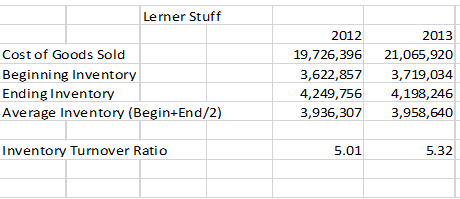
The ratio is only difficult to calculate if a business’s inventory varies significantly throughout the year. Inventory Turnover is calculated as Cost of Goods Sold divided by Average Inventory. The Cost of Goods Sold is always calculated for the Income Statement, so the figure is readily available. Average Inventory may be trickier. For businesses with fairly constant inventory levels, simply add Beginning Inventory to Ending Inventory and divide by two to calculate a simple average.

This simple average doesn’t always work well, however, because many businesses have significantly less inventory at the beginning and end of the year than at other times. The simple average, therefore, uses an artificially low denominator, which tends to overstate the Inventory Turnover Ratio.  So, if monthly inventory figures are available to calculate the average their use will provide a truer Inventory Turnover Ratio:

Using information from the table above, we can calculate Lerner’s Inventory Turnover Ratio for 2012 and 2013. The ratio is determined by dividing Cost of Goods Sold by Average Inventory for each year. For 2012, the calculation is 19,726,396/3,936,307=5.01. For both 2012 and 2013, Lerner turned over its inventory slightly more than five times per year. Bankers interested in Lerner’s Inventory Turnover Ratio would likely compare the Lerner ratio against those of other companies in the same industry. A turnover ratio significantly below those of Lerner’s peer group might cause bankers concern about inventory obsolescence.

Let us know if you would like to see how your ratio stacks up against those of your peers, or to discuss how to improve your ratio.

Filed Under: Business Growth, Business Planning, Cash Flow Planning, Financial Modeling, Key Performance Indicators, Numbers Coach TIPS, Rolling Financial Forecast, Working Capital Tagged With: cash flow forecast, cash forecasting, cash planning, financial metrics, inventory management, inventory turnover, key performance indicators, KPI, preserving cash, working capital management

Reassess Your Customer Credit Practices for Stronger Financials

September 29, 2020 by greenmellen

by Anne Moore Odell

Every time you send out an invoice, it is like you are granting a loan to your clients. Business is built on trust with products and services moving around the world on the foundation that invoices are going to be paid in a timely manner.

However, extending credit can’t happen in a vacuum. It is up to you to create credit policies that keep your cash flow and business healthy. And while having good credit practices in place is always important, it is especially important to make wise credit decisions in today’s difficult economic times.

Here are 5 tips to help you create sound credit policies:

 1. Take the Time to Research

Now is the time to revisit your credit application process. Make sure that your application is thorough. Make the effort to call all supplied references and banks. Although clients are only going to supply positive references, you can still learn a lot about how potential clients work.

Do your homework on prospects by going to the library where free information from publicly traded companies can be found. Consider using a professional credit report service like Dun & Bradstreet , TransUnion or Equifax. For a small fee they can provide credit histories, records of liens against companies, and current financial obligations on larger clients.

“Don’t forget to use your contacts with the various business associations you belong to – they can help gain information about credit decisions,” suggests Mike Iverson, CEO of Trillium Financial. “Through these relationships and through relationships with other vendors, you can learn about potential clients. You might also require information from clients’ accountants, and tax returns,” says Iverson.

2. Consider using a Z-Score 

A Z-Score is a calculation that allows you to figure out the financial health of a company by using ratio values for a “score” that can indicate potential future bankruptcy. A Z-Score calculator can be located at either The Accounts Receivable Network (membership site: www.tarn.com) or at JaxWorks (http://www.jaxworks.com/calc2a.htm )

3. Be Selective

Keep your customers’ credit files up to date. With businesses going bankrupt and changing hands, it is important to update your credit information on existing clients, increasing or decreasing credit limits as needed.
“In this market you need to be discerning regarding who you are offering your services and products to,” says Marc D. Smith, Vice President, Magnolia Financial, Inc, based in Spartanburg, SC. “Fire customers if they don’t meet your credit requirements.”

Because of the reduction in sales that many businesses are seeing across sectors and industries, businesses are facing increased pressures when it comes to extending credit. However, just because a client is interested in your product or service it doesn’t mean that you need to accept every application.

“In my experience, people are lowering some of their credit limits,” says Iverson. “You should consider your accounts receivables to be much like an investment portfolio—you have invested in your customers and you want your portfolio to be profitable.”

Working with customers before problems and outstanding invoices occur is the best approach. In some cases, you can work out new payment schedules. It is also important to include your entire team so that salespeople know clients’ credit and payment histories.

4. Follow Up

“In good or bad times, one of the keys to collecting from customers is timely and accurate billing,” explains Mike Iverson, CEO of Trillium Financial. “That sounds like a no brainer, but sometimes that doesn’t happen. An invoice might have to be approved or reviewed by several different people, which can cause you to lose two, three, or four days in collecting your invoice.”

One effective practice for larger bills is calling to follow up on an invoice two or three days after it is sent to see if everything is in order. This practice not only puts you top of mind with your client but acts as a customer service call that could generate more sales. If the client does have an issue with the bill, then you can quickly solve the problem, generate another invoice and get paid on time.
Another proactive practice is to send monthly statements or even bi-weekly statements, again reminding clients before bills become overdue.

5. Good Relationships are Important

All levels of management are becoming more involved in credit decisions as businesses look to keep the cash coming in. These days CFOs and CEOs are participating in credit decisions with their teams.

One of the main points to remember, however, is that while economic downturns will end, the relationships you form today will continue. Working to preserve the business relationships you have now and creating new working relationships not only generates good will, but also builds a strong foundation to catapult your business when the economy rebounds.

Filed Under: Blog, Business Growth, Business Planning, Cash Flow Forecasting, Cash Flow Planning, Employer Tips, Financial Modeling, Financing a Business, Key Performance Indicators, Rolling Cash Flow Forecast, Rolling Financial Forecast, Working Capital Tagged With: business cash flow, cash flow, cash flow forecast, cash forecasting, collection tips, credit practices, working capital management

Cash Reserves Help Your Business Weather the Storm

November 3, 2015 by greenmellen

by Michael Iverson

“Save it for a rainy day” is an old saying that still makes sense today. In good times, it’s smart to put aside something for the lean times that are sure to follow.

For a business owner, saving for a rainy day means building cash reserves. Liquidity is the lifeblood of any business, and a lack of liquidity is the cause of most business failures. Squirreling away cash during times of prosperity may, one day, save your business.

A cash reserve provides a business owner with the financial flexibility to continue operations during difficult times. In a sluggish economy, for example, a business may receive less cash from operations than anticipated. Customers who lose jobs are unable to pay their accounts on time. As a result, the business owner finds there’s simply not enough cash coming in to meet business expenses.

The owner can’t very well tell employees and vendors that they won’t be paid until customers pay their accounts, or he risks driving them away. A wise business owner wants to keep his employees and vendors happy, so he pays them on time. He usually does so by tapping into the cash reserve he established during good times.

Cash Reserve vs. Line of Credit

Business owners that have the foresight to build generous cash reserves are sometimes reluctant to tap those reserves. When difficult financial times arrive, a business owner shouldn’t feel any guilt about putting those reserves to use. The funds were saved with a specific purpose in mind—one day the business might not be able to generate adequate cash from operations.

When that day arrives, the question to ask is whether it’s best to dip into the cash reserve fund or make use of an available credit line. Usually, the conservative stance that led the owner to build cash reserves prevents him from taking on debt. But, there are circumstances when using the credit line makes sense. We recommend that you pose the question to your financial advisor.

When it’s considered best to use the cash reserve fund, the money will be put to good use. It will pay the salaries of your employees that have helped you achieve so much over the years. Hopefully, they will continue to be productive employees for years to come. This is a time for looking ahead. Make it a celebration of good business planning and loyal employees.

Opportunity Knocks

Cash reserves may also provide unexpected opportunities. Suppose a competitor of yours is highly leveraged. He has grown his business using borrowed money. He didn’t anticipate an economic downturn and never gave much thought to putting aside cash for a rainy day. What happens if his customers can’t pay their bills in a timely manner? He will have a tough time making payments on his business loans. If the problem is serious enough, he might be forced to liquidate the business. His customers could easily become new customers of yours. His employees might become your employees.

Not sure how to reserve some cash every month?  Contact Michael for advice on how to modify your current business financial model to weather future storms.

Filed Under: Blog, Business Growth, Business Planning, Cash Flow Forecasting, Cash Flow Planning, Employer Tips, Financial Modeling, Key Performance Indicators, Rolling Cash Flow Forecast, Rolling Financial Forecast, Working Capital Tagged With: cash conservation, cash flow, cash flow forecast, cash forecasting, financial leadership, preserving cash, successful characteristics, uncertain cash flow, working capital management

Put Your Working Capital to Work in Understanding Your Financial Dashboard

November 3, 2015 by greenmellen

by Michael Iverson

I often remind clients to pay attention to their working capital levels, particularly in today’s economic environment, when banks have shown a reluctance to lend to small businesses. Business owners need to maintain liquidity, generate positive cash flow and – to the extent possible – prepare to fund growth internally. Working capital is critical to your financial dashboard, a tool we recommend you as a business owner use to monitor your financial health.

Understand Working Capital

Let’s begin by defining working capital. Simply stated, it is the difference between current assets and current liabilities. A common perception is that a profitable business always has adequate working capital; however, that is not necessarily true. Profitable businesses can, and do, experience capital crunches. Often, an effort to expand operations aggressively is the cause of a shortage of working capital.

Working capital is composed of primarily of Accounts Receivable, Inventory, and Accounts Payable. A business owner needs to consider changes to these short-term assets and liabilities in order to ensure the business generates adequate operating cash flow.

For example, an increase in Accounts Receivable might mean a business is falling behind its in collections. Sales offered on credit, a business is effectively making a non-interest bearing short-term loan to its customer. Collecting accounts promptly is important. An aged invoice that goes past its due date can have a negative effect on cash flow. The business used precious resources to bring a product to market and sell it, but until the account is collected those funds are unavailable.

For my clients that extend credit, I recommend a dashboard metric called Days Sales Outstanding (“DSO”). It measures the relationship between Accounts Receivable and Sales. When this metric spikes higher than a specified level, then collections are not keeping pace. A quick glance at the dashboard shows you the trend of the metric. Measuring and understanding the drivers of the metric can help you identify where to make changes.

For businesses with inventory, it’s important to make sure that inventory is not consuming capital unnecessarily. Is inventory getting sold on the schedule? As with aging Accounts Receivable, a buildup of inventory ties up your cash resources when it is not converted to cash on a timely basis. The Inventory Turnover Ratio is a dashboard metric that highlights this trend. When the ratio decreases, it can signal an upcoming cash flow problem.

Another balance sheet account in working capital is Accounts Payable. Accounts Payable is the opposite of Accounts Receivable, where your business has been extended a short-term interest free loan from your vendor. When a business slows down its vendor payments, it is conserving cash. A business will at times use this strategy when it is experiencing slower payments in Accounts Receivable. Days Payable Outstanding (“DPO”) is a metric that measures your payment cycle trend. Consider putting it on your dashboard. Measuring your DPO helps identify when you may be disbursing funds faster or slower than expected.

Working Capital Ratios

To recap, here are the Working Capital ratios that I recommend you measure:

  • Days Sales Outstanding
  • Inventory Turnover Rate
  • Days Payable Outstanding

If you don’t understand the relationship of these metrics on your operating cash flow, your business can quickly become a very profitable operation that is very quickly running out of cash.

Developing a financial dashboard helps you manage review key metrics to gain insights on making decisions for your business. Schedule a free consultation with our Numbers Coach, where we are glad to discuss metrics that make the most sense for your business.

Filed Under: Cash Flow Planning, Financial Metrics, Financial Tools, Key Performance Indicators, Numbers Coach TIPS, Own Your Numbers, Working Capital Tagged With: financial dashboard, financial management, financial metrics, key performance indicators, KPI, metrics, working capital management

Back to Banking Basics

November 3, 2015 by greenmellen

by Anne Moore Odell

Is that a ray of sunlight peeking through the economic clouds? Yes, banks are still lending to small businesses. True, loans aren’t as easy to secure as they were three years ago. But businesses that are willing to work to show their ability to repay lines of credit and loans are still getting financial support.

“Things are starting to loosen up,” says Mike Iverson, CEO of Trillium Financial. “Bankers are opening their doors again.”

Banks are getting back to the basics of lending. As a business owner, this means you need to re-familiarize yourself with these basics and make sure your business is ready to request that loan.

Sailing through the Five “Cs”

The “Five Cs” of business credit are more than a banking concept learned in business school. As banks pull back their lending reins, they are investing more time to learn about their clients’ businesses before lending.

“Banks are really looking at lending from a basic banking process,” explains Iverson. “They’re not going to take the same risks they were before. Banks are monitoring loans downstream. Before, some loans were unmonitored, but as businesses want to renew their loans, many banks want to see more information on a more regular basis. You’ll be hard pressed to see unmonitored loans of a million dollars anymore. Even much smaller loans are being monitored quarterly.”

With your business loan application in hand, the bank’s lending committee will examine how well your business can repay its loans according to five critical factors:

  1. Character. The lender is looking at you both as a business owner and a manager. Your character includes your personal financial history, reputation, and, importantly, your relationship with your lender.
  2. Collateral. Both business and personal collateral. More banks are asking for business owners and partners to sign personal guarantees so that loans are secured at an acceptable margin.
  3. Capacity. More than ever, banks require you to demonstrate your capacity to repay the loan. Although the recession has changed and often slowed down cash flow, lending committees must be convinced that your business has the liquidity and cash to repay on time.
  4. Capital. By supplying current, in-depth and correct financial information to your bank, a lender can understand that your business has the capital structure to survive and thrive in these tough economic times.
  5. Conditions. You also need to show that you understand the conditions of your industry, the economy and other factors that could impact your ability to repay the loan.

Communication is Key

Be upfront on your application and honest with your banker on where and when risk could occur. Communicate your business plans and clearly explain to your banker how you plan to use the borrowed funds. Once you have your secured your loan, keep the lines of communication open between yourself and your banker.

“If you have bad news you need to tell your banker ‘here is the issue, here is how I plan to address the issue,’” says Iverson. “If they get surprised, they get worried.”

Filling out a loan application and talking to your banker shouldn’t be an angst-filled experience. The irony is that when you don’t need a loan, when your cash flow and income are high, it is the best time to apply for one. “You get the loan, you use it, you pay it back it back, and you show the bank that you have the management and cash flow to do it,” adds Iverson.

Even in these tough times there are lenders ready to loan money to well-run businesses. Remember the five “Cs” and always communicate with your banker in good times and bad times.

Filed Under: Acquisition of Business, Business Growth, Cash Flow Planning, Financial Modeling, Key Performance Indicators, Numbers Coach TIPS, Rolling Cash Flow Forecast, Rolling Financial Forecast Tagged With: banking, business capital, capital funding, funding a business, loans, working capital management

Capital Financing: Back to Banking Basics

November 3, 2015 by greenmellen

by Anne Moore Odell

In these challenging economic times, it can be difficult for businesses to know where to turn for capital financing opportunities.   The answer might be right around the corner at your local community bank.

”It is going to be the small businesses that drive the economy and new jobs, not the government,” says Mike Iverson, CPA and principal of Trillium Financial. “People need to talk to their bankers now.   Your bank needs to get an understanding of your current situation.  Don’t wait until 30 days before your line of credit comes due.”

“Banks are not charitable organizations, but are in business to make money,” says Phyllis Murdock, Senior Vice President of Private Entrepreneurial Banking at the Buckhead Community Bank.   The bank serves businesses around metro Atlanta. She elaborates, “We will consider the traditional five C’s of Credit:

  1. Capacity to repay
  2. Capital invested in the business
  3. The Collateral or ‘guarantees’ that provide supplemental forms of repayment
  4. The Conditions surrounding the loan
  5. Character of the borrower.”

To get capital funding from banks, businesses must demonstrate their ability to repay loans.  Banks look carefully at cash flow from the business and the timing of the repayment.   Says Murdock, “We’ll take a look at past credit relationships, both individual and commercial, and payment history if this is a renewing line. There may be contingent forms of repayment—these will come into play as well.”

In response to downward economic trends, banks are looking at all lines of credit and requests for capital with greater scrutiny, including close examination of another of the five “C”s of credit:  Collateral.  Equipment, buildings, accounts receivable and in some cases inventory may all be sold by the bank for cash.  If accounts receivables are to be used, banks might request an “aging receivables” report and monitor the accounts receivables during the life of the line of credit.  Both business and personal assets of owners are considered.

Murdock explains, “The money that the applicant has personally invested in the business becomes an indication of how much the principals have at risk should the business fail.  This is the capital injection and we believe that the borrower who has significant personal investment in the business is more likely to do everything in his power to make the business successful.”

“It is very important to talk to your bank regularly and them updated on any significant changes to your business — good or bad,” says Iverson.  Murdock adds, “Local banks understand the economic climate of the community that they serve and have a willingness to invest in that community. Frequently bankers are invested in the community and have a true understanding of what is occurring in the town.”

Current conditions have made banks very cautious, lending only to clients with whom they have had previous relationships. Stay in touch with your banker and other financing partners.  It can make the difference in getting your loan renewed.

Need help getting your financials in order to approach your bank?  Contact Trillium today!

Filed Under: Acquisition of Business, Blog, Business Growth, Cash Flow Forecasting, Cash Flow Planning, Financial Modeling, Key Performance Indicators, Rolling Cash Flow Forecast, Rolling Financial Forecast, Working Capital Tagged With: banking, business growth, capital funding, company growth, funding a business, loans, working capital management

NumbersCoach_Logo_green-gray_stacked

Proud Supporter of

Screenshot 2025-09-09 150120

Get Financial Tips Delivered To Your Inbox

Protect your business' financial health with our monthly financial tips.

Contact Info

P.O. BOX 250
Decatur, GA 30031

404-353-2148

info@numberscoach.net

© 2026 Trillium Financial, Inc
Privacy Policy | Accessibility | Terms