
NumbersCoach_Logo_Endorsed_UnderLogotype_2
  • Numbers Coaching
    • The Numbers Navigator®
    • Case Studies
  • About
    • Trillium-Numbers Coach Story
  • Resources
    • Blog
    • Numbers Coach TIPS
    • Podcasts
    • Numbers Coach Tools
  • Numbers Coach University
  • Contact
  • Search

Conquering Email Is Crucial to Time Management

August 7, 2023 by greenmellen

We’ve all heard the old adage, “Time is money.”  It’s as true today as when it was first coined. Be mindful of your time because it truly is one of your most valuable assets.

Yet trying not to waste time is easier said than done. One of the most likely causes of an unproductive day is the mismanagement of an email inbox.  So, let’s consider a strategy you can use to help master your inbox and thereby better manage your time.

email marketing

The simplest and most effective strategy I have heard about is the one I use daily:  Try responding to incoming email just twice during the day. 

Does that notion sound crazy?  That was my initial reaction, but I can assure you it works like a charm.  As far as I am concerned, it’s the ultimate email hack.

Twice-a-Day Email: Why It Works

Think about societal norms in terms of communications. In the business world, email and phone are the two most common means of communication. If you have an immediate need from either a vendor or a team member, aren’t you likely to pick up the phone?  It conveys a sense of urgency.

The expected response time for an email received is somewhat less urgent. Generally speaking, the business world has an expected response time for email that is measured in hours, not minutes. For the average office, responding to email within 24 hours is reasonable.

The expectation for your office might be more stringent. I decided to try to get back to my clients within half a business day, which is why answering email twice a day became my standard.  I look at my email inbox once at noon and once at the end of the day.  I respond to all my incoming morning email at noon and catch any afternoon email by the end of the day. There is rarely a need to respond in real-time.

Noon and end of day are my favored times.  Any two times during the day would probably work fine.  When I come to work each day, I am intent upon completing a particular task. I want to focus all my energy for the most productive time of day (first thing in the morning for me) on that task.

I used to look at email first thing in the morning, and sometimes I would get sidetracked.  Too often, the task most important to me that day still was not accomplished by midday.  That bothered me. Once I committed to answering emails at two set times each day, all the email alert noises I had set could be shut down.  I came to think as them as distractions to my productivity; they were interruptions to my train of thought.

I tell my clients that email is my preferred means of communication, but I explain how I manage my email and ask them to call whenever something needs immediate attention.  It’s a system that people seem comfortable with, and it certainly has improved my productivity.

More Ways to Save Time

Here are a couple of more ways to save time spent responding to email.

  • Have templated signatures for responses to frequent email requests.
    For example, if you are getting LinkedIn requests from people you don’t know, you might have a signature template that reads something like:  “Thanks for your LinkedIn inquiry.  I am always interested in learning more about colleagues of my business connections. Who is our common connection point?”
  • With customer orders, have a customized thank you email where you can insert the customer’s name and an authentic thank you. 

Taming email is one of the surest ways to improve productivity – yours and that of your employees.  As you find ways to improve, be sure to share them with your team.
Are you looking for more ways to improve productivity at your business?  Contact Trillium Financial

Filed Under: Employer Tips, Numbers Coach TIPS, Personal Development, Productivity Management Tagged With: email management, productivity, productivity tips, time management

What’s the Deal with Working Capital?

November 3, 2022 by greenmellen

A Unique Look at Asset Based Lending
by Marc Smith

“Cash is King.”  We’ve all heard the expression, but if you haven’t owned your own business, you likely haven’t given it serious thought.

When a business is for sale, most people first want to know about the total revenue (sales) and the net income (profit).  These two factors are extremely important, but any business owner would argue that there is another factor that is even more important than these two:  Operating Cash Flow or Working Capital.  Profits are great, but no matter how much money is coming in the future, a business can’t continue to operate if it doesn’t have enough cash to cover this week’s payroll.

Let’s use an example of a recent business acquisition: 

XYZ Company is acquired by an eager buyer who uses an SBA Loan to finance the transaction.  Everything starts out great for the new owner:  their new business is growing, sales are up and they are enjoying the rewards of self-employment.  XYZ Company has many new orders to fulfill or new contracts to service as a result of this growth.  The working capital associated with this expansion are typically paid up front while the company won’t receive the benefits until the customer remits payment (sometimes months down the road).  As the new opportunities develop, the up-front costs associated with these opportunities keep increasing.  Before long the owner is looking at a significant cash gap from what is owed to suppliers now versus the cash that customers will not remit for another 30-45 days or more.

The owner realizes that with the recent growth, there is a need for a line of credit.  Obtaining additional funds or refinancing with the SBA Lender typically isn’t an option, so they inquire with their local bank for conventional financing.  This presents a problem:  all business assets are already collateralized with the SBA Loan, leaving the bank with no collateral.  Therefore, the bank is not willing to extend the company a line of credit.  This leaves the owner in quite a predicament:  sales are up and the future looks bright; however, the short term cash flow constraints are keeping the company from taking advantage of that growth.

Profits are great, but no matter how much money is coming in the future, a business can’t continue to operate if it doesn’t have enough cash to cover this week’s payroll.

– Marc Smith

It is this type of situation that can potentially be resolved with an Asset Based Loan.  Typically secured by Accounts Receivable, an Asset Based Loan provides working capital to a business.  It does not add cash to the business, it simply accelerates cash flow by allowing a business to borrow against the future value of its receivables that are expected to become cash in the near term.

The SBA Lender is many times willing to “release” the Accounts Receivable to the Asset Based Lender because this provides the company with additional liquidity.  By working with the Asset Based Lender, the company now has the capital it needs for growth without worrying about how it will meet its short term cash demands.

Marc Smith is a Vice President with Magnolia Financial, Inc., an Asset Based Lender that provides Accounts Receivable Financing and Management to growing companies that are typically unable to obtain traditional bank loans.  He can be reached at msmith@magfinancial.com or (404) 664-7037.

Filed Under: Blog, Cash Flow Forecasting, Cash Flow Planning, Financing a Business, Key Performance Indicators, Working Capital Tagged With: business financial planning, cash conversion cycle, cash flow forecast, financial management, preserving cash, working capital, working capital management

Small Changes Lead to Big Productivity Results

September 13, 2022 by greenmellen

Some people seem to have the golden secret to being highly productive. They may be naturally motivated and organized, but in truth, everyone has the power to increase their productivity. It’s all about habits. There are small, very feasible changes that when done repeatedly become habits. Even people who seem inflexible and stuck in their ways can learn to be productive.

We’ve highlighted a few of our favorite productivity tips below:

  • Prioritize. It’s fine to write a 5-page to-do list, but make sure to separate the “must happen today” list from the “must happen this week/month/year” list. There’s also the “would be nice if it ever happens” list. You get the picture. There is a saying about the “power of three” which I use for my daily work.  Listing only three priorities on my daily “to do” list in order of priority.  I start on the first priority on the list, and I don’t go to the second one until the first one is completed.
  • Give yourself deadlines. Deadlines are powerful psychological tools. If you are expected to give a presentation on Friday, you would get everything done, even if you cram it in at the last minute, right? For most people, simply having the intention to do something “soon” or “eventually” means there’s a good chance it won’t get done at all. The more time you must do something, the longer it will take you to do it.  Set a date and stick to it!
  • Make work time work time. Have a specific work area and everything ready to go when it’s work time. Keep distractions at a minimum. Stay focused and avoid podcasts, TV, social media, online shopping, email, and unplanned phone calls. Turn off all unnecessary notifications and alarms. You’ll be amazed at how your production skyrockets. Find the time of the day you feel best suits your energy levels and block off a 3-4-hour chunk of time to do your deep work.
  • Keep your free time free. Time is not renewable, so honor yours. It’s quite easy to cram too much into a day and feel guilty when you don’t get everything done. It’s ok to say no to someone if it is not a priority that fits into your day. Resist the temptation to rearrange your schedule to make room for more obligations. As Derek Sivers, founder of CDBaby.com, says about making commitments:  “If it is not a heck yeah, it is a no!”
  • Take a walk. It’s not new news that physical activity is good for you. Add “increased productivity” to the list of walking benefits. Walks are refreshing and they provide much needed breaks, fresh air, and renewed energy. Don’t think you have time for it? A 5-10 minute walk will do the body (and mind) good.
  • Drink water. This is another one that we hear all the time. That’s because your body and your mind need enough water (2.5 liters/day for women and 3.5 liters/day for men) to operate at 100%. Dehydration impacts cognitive and motor functions, skin, mood, and more.
  • Take regular breaks. Everyone is different so be mindful of what you need for optimal productivity. Some people do best by working 25 minutes followed by a 5-minute break (pomodoro technique), while others do better work for an hour then taking a 10-minute break. These mini breaks are powerful when used correctly and can drastically improve a person’s ability to focus. Feel free to set a timer if it helps you to stay on track!
  • Prepare the night before. A day that begins by scrambling to find matching shoes, a coat, lunch, medication, your laptop, workout clothes, etc., is not fun. In fact, it’s stressful. I don’t regret waking up feeling prepared for the day ahead. So go ahead and make that list ahead of time.

While this list of tips might seem simple, implementing these small changes into your daily schedule can lead to big results. You will feel more productive in your work time, and you might even feel as if you have more free time.

Filed Under: Business Planning, Cash Flow Planning, Employer Tips, Financial Modeling, Human Resources, Leadership, Numbers Coach TIPS, Personal Development, Productivity Management Tagged With: employee engagement, habits, how to be productive, leadership characteristics, leadership habits, leadership traits, productivity, productivity tips, successful characteristics, traits of success

7 Traits of Successful Leaders

July 20, 2022 by greenmellen

All business leaders are not alike. There are many different leadership styles, all of which can be successful. However, if you take a handful of department heads with unique management styles, and you will see very similar traits in all of them.

The seven traits that are common to most successful business leaders include the following:

  1. Authenticity.  People can sense authenticity and authenticity is directly related to trust. Employees are much more likely to work hard for someone who is the “real thing.” True leaders stay true to their values regardless of the pressure that they are under to act otherwise. They are honest with themselves and others, and take responsibility for their mistakes.
  2. Resilience.  There will always be challenges in work and home life — what’s important is how one responds to the challenges. A great leader not only faces challenges head on, but also grows stronger as a result.
  3. Ability to delegate. Delegating is difficult for many leaders, but it’s important. Leaders who are good at delegating show employees that they have trust in them and have confidence in them. Delegating promotes learning and growth in employees.
  4. Empathy.  Empathy can make the difference between good and bad leaders. Being able to put yourself in someone else’s place is a skill that many managers or top executives lack. A leader who shows empathy toward direct reports is more likely to be viewed as a better performer by “higher ups.” People will work hard for and appreciate an empathetic leader who demonstrates compassion.
  5. Excellent communication.  This one seems obvious but can sometimes be overlooked. This means communicating with a variety of people in a variety of ways, including social media, text, phone calls, Zoom meetings, email and face-to-face. Don’t forget that active listening is just as important as talking. Listening to concerns, asking for feedback, and showing appreciation all play vital roles in how a leader is viewed. Communication is also not always verbal, but seeing non-verbal cues is a quality in an effective leader. The quality of excellent communication directly correlates to the success of a business.
  6. Honesty. It’s often hard to speak up in the workplace, especially to executives, but it’s a trait that is essential to a thriving business. It’s easy for resentment to build and gossip to begin when employees don’t feel comfortable sharing ideas and opinions. Good leaders have the courage to be honest and demonstrate the ability to discuss difficult topics. Leaders intentionally create an environment that encourages employees to do the same.
  7. Respectful.  People who feel like their boss respects them work much harder to meet goals than those who don’t. Respect motivates people to trust others and to work hard to meet and exceed expectations. Employees who have the respect of a manager, also have a sense of purpose and feel valued by their company. A lack of respect can oftentimes lead to a lack of motivation and mediocre work.

What traits are your strengths?  Where are you not as strong?  Having these traits as part of your leadership team will help set the tone at your business and its course of success.

Filed Under: Business Growth, Employer Tips, Human Resources, Leadership, Numbers Coach TIPS, Personal Development, Productivity Management Tagged With: leadership, leadership characteristics, leadership coaching, leadership style, leadership traits, success habits, successful characteristics, successful people, traits of success

What Your Inventory Turnover Ratio Is Telling You

May 6, 2022 by greenmellen

Bankers who lend to small businesses in manufacturing and distribution often calculate a client’s inventory turnover ratio. “What are the bankers looking for in a ratio?” clients sometimes ask.

First, bankers wonder whether the business is carrying inventory that is disproportionate to its sales. Carrying excess inventory is not a productive use of capital when money is tied up in product that sits on a shelf and incurs warehouse costs.

A second concern for lenders is that inventory not turned over quickly will become obsolete, damaged, or outdated. In any of those circumstances, revaluation of the inventory is necessary and losses must be booked. That’s a concern to lenders.   Also a decreasing turnover rate could indicate a slowing sales and lower profit trend.

Calculating the Ratio

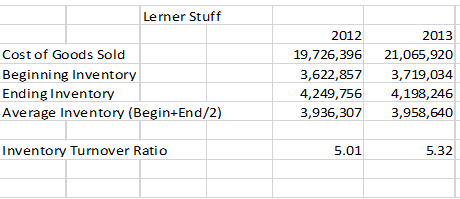
The ratio is only difficult to calculate if a business’s inventory varies significantly throughout the year. Inventory Turnover is calculated as Cost of Goods Sold divided by Average Inventory. The Cost of Goods Sold is always calculated for the Income Statement, so the figure is readily available. Average Inventory may be trickier. For businesses with fairly constant inventory levels, simply add Beginning Inventory to Ending Inventory and divide by two to calculate a simple average.

This simple average doesn’t always work well, however, because many businesses have significantly less inventory at the beginning and end of the year than at other times. The simple average, therefore, uses an artificially low denominator, which tends to overstate the Inventory Turnover Ratio.  So, if monthly inventory figures are available to calculate the average their use will provide a truer Inventory Turnover Ratio:

Using information from the table above, we can calculate Lerner’s Inventory Turnover Ratio for 2012 and 2013. The ratio is determined by dividing Cost of Goods Sold by Average Inventory for each year. For 2012, the calculation is 19,726,396/3,936,307=5.01. For both 2012 and 2013, Lerner turned over its inventory slightly more than five times per year. Bankers interested in Lerner’s Inventory Turnover Ratio would likely compare the Lerner ratio against those of other companies in the same industry. A turnover ratio significantly below those of Lerner’s peer group might cause bankers concern about inventory obsolescence.

Let us know if you would like to see how your ratio stacks up against those of your peers, or to discuss how to improve your ratio.

Filed Under: Business Growth, Business Planning, Cash Flow Planning, Financial Modeling, Key Performance Indicators, Numbers Coach TIPS, Rolling Financial Forecast, Working Capital Tagged With: cash flow forecast, cash forecasting, cash planning, financial metrics, inventory management, inventory turnover, key performance indicators, KPI, preserving cash, working capital management

Mastermind is the Name of the Game

May 6, 2022 by greenmellen

What is a mastermind group? This timeless concept is explained by Napoleon Hill in his books published in the 1920s and ’30s, The Law of Success and Think and Grow Rich.

Some mastermind groups are informal with 2-3 people and other groups are more formally organized, such as organizations like Vistage (www.Vistage.com), YPO (www.YPO.org), or View From the Top (www.viewfromthetop.com).   More formal mastermind groups consist of approximately 8-12 peers who meet on a regular basis (weekly or monthly) either in-person or via Zoom. Members pay monthly dues, and their fee often covers in-person speaker(s), activities, and/or retreats.

CEO & Co-Founder of Sustainable Investment Group (www.sigearth.com), Charlie Chichetti, has belonged to a 10-person mastermind group, Iron Sharpens Iron (“ISI”) as part of the View From the Top, for the past six years. Chichetti says the strength of a group lies in the diverse personal and business experiences of its members. Participants share best practices and hold each other accountable for tackling problems and meeting goals. Each member takes a turn in the “hot seat,” while the rest of the group brainstorms strategies and solutions to aid them in facing their challenges head on. A successful mastermind group enhances its members’ business AND personal lives.

Make no mistake, these formal groups like Vistage and ISI are not laid-back clubs.  Attendance and participation are  required. Members are expected to present problems, as well as provide feedback. The group devises a method of holding members accountable for following through, which keeps everyone focused and on track.

Charlie Chichetti offers the following guidelines to create an efficient and productive mastermind group:

  • Meetings are not the time to multi-task; they should be structured and begin and end on time.
  • Be present – both physically and mentally.
  • Members should come with a giving—as opposed to taking—mindset.
  • Include a mix of members, including “solopreneurs,” people from small- to large-size businesses and from different industries.

Trace Blackmore, owner of Blackmore Enterprises (www.blackmore-enterprises.com), has been part of a mastermind group for the past 10 years. He currently facilitates a mastermind group, Rising Tide (www.scalinguph2o.com/mastermind), and is a firm believer that learning from others’ mistakes and successes is one of the best tools for good decision making. Like Chichetti, Blackmore contends that the structure of mastermind groups is key to their success. He provided the following guidance to anyone who is part of a mastermind group, or is considering joining one:

  • All devices should be on silent mode during the meetings.
  • Progress is expected every week and a group may choose to offer consequences for members who come unprepared.
  • Before deciding to join a mastermind group, be sure you have the time, energy, and desire to make it a priority.
  • Each meeting should start by celebrating wins. Support and accolades are integral to keeping members motivated.
  • Ask questions! Questions help people think and look at circumstances from different perspectives and keep people from jumping to conclusions until they have all the information.
  • Members should be honest, while doing so in a tactful way. A book titled Fierce Conversations by Susan Scott is a good resource.
  • Individual goals and plans should be clearly verbalized to the group and should include deadlines for completion. This keeps people focused and on track.
  • What happens in mastermind stays in mastermind. Like all of life, business and personal events overlap, and problems and solutions are often of a personal nature.

Now you are officially aware of the who, what, when, where, and why and of mastermind groups. The benefits— accountability, strategy development, and healthy business and personal habits—are invaluable. Perhaps you will think it over and decide that membership is right for you.

As a member of a mastermind group for 10+ years now, I’m happy to advise you if you are thinking of joining one.   Feel free to contact me to discuss.

Filed Under: Business Growth, Employer Tips, Human Resources, Numbers Coach TIPS, Personal Development, Productivity Management Tagged With: employee engagement, financial habits, habits, leadership, leadership characteristics, leadership coaches, leadership coaching, leadership traits, success habits, successful people, traits of success

The Positive Power of a Flexible Workplace

March 10, 2022 by greenmellen

Employers, employees and studies say remote working in many instances can result in more productivity. The past two years guarantee that an increase in remote working will be a permanent result of COVID-19.

When people work from home, they have more control over their time and working environment. Employees work when they are most productive, which is not always regular business hours. People who work from home tend to dress comfortably and can fit more exercise and sleep into their schedules.

Traditionally, extra sleep and comfy attire for staff are not high on the list of employer goals. In fact, it may seem like these factors are counterproductive. But many employers say remote work has had a direct and positive result on business. Employees are happier, healthier (more sleep and exercise), take fewer sick days and accomplish more than those who spend the entirety of their work hours in an office.  Communication by text, email, Zoom and phone is proving to be more efficient as people focus more intently on their time management with these channels.

Call center employees, for example, take more calls when they work remotely, in part due to less noise and generally fewer distractions at home (apart from slightly distracting unsupervised toddlers), as opposed to a busy office.

Job satisfaction tends to increase without a daily commute. There is the appeal of a commute-free lifestyle. Statistics show that traditional commuters suffer from high blood pressure, high blood sugar and high cholesterol, more often than those who commute from the kitchen to the office down the hall. Increased anxiety is also associated with a commuter lifestyle.

People value a remote workplace option and may opt to take a pay cut for a job that offers it.  Having the flexibility to work even with a hybrid model of home office and work office environments can add a dimension to a job that makes it attractive.  The greater acceptance of a work-from-home option has opened the opportunity to reduce geographic limitations when recruiting.  Hiring employees is not cheap and a high rate of employee retention helps both overall morale and the bottom line.

Pandemic-life has proven that working remotely, at least part of the time, is feasible and profitable. Businesses can use remote working to their advantage to pivot their company and meet the demands of a new reality.

Filed Under: Employer Tips, Human Resources, Leadership, Numbers Coach TIPS, Personal Development Tagged With: business planning, employee engagement, employee management, employee wellness, hiring employees, leadership

Prioritization: The Foremost Rockefeller Habit

January 7, 2022 by greenmellen

One of the best ways to improve your work productivity is to emulate the habits of someone highly successful. John D. Rockefeller, who founded the Standard Oil Company in 1870 and ran it until 1897, is one of the true titans of American business. And so, the book Mastering the Rockefeller Habits by Verne Harnish made its way onto my reading list.

As the book documents, Rockefeller’s approach to running a growing business was really quite simple. He identified three underlying habits that he considered essential to good business management:

  1. Setting priorities for the organization.
  2. Collecting and analyzing sufficient management data.
  3. Establishing an effective organizational rhythm.

Of the three key habits, setting priorities is first, and arguably the most important.

Setting Company Priorities

Rockefeller developed a list of the Top 5 priorities of his business for the upcoming year and the next quarter. He also ranked those top priorities in order and set a clear Top 1 priority from among his Top 5. He communicated these priorities throughout his company and encouraged employees to set personal priorities that aligned with and supported the company’s priorities.

It seems to be common sense to solve the problem at hand before moving on to another challenge, but not every team or employee has the discipline to follow through to completion of a difficult task. Rockefeller’s managers provided the discipline needed to make sure the top priority was completed before the second priority was undertaken.

As productivity tools go, Rockefeller’s Top 5 priorities list is one of the most widely used in American business history. As an example of the effectiveness of the tool and how soon it came to be appreciated by others, Harnish relates the story of a management consultant who was summoned to the office of Charles Schwab in the early 1900s. At the time, Schwab was the CEO of Bethlehem Steel, and he was looking for ideas to improve the business.

The consultant told Schwab how he could improve Bethlehem Steel’s bottom line by using a simple productivity tool. It was Rockefeller’s Top 5 priorities list.

The consultant told Schwab to start each day by writing down the top 5 things he wanted to accomplish for the company’s benefit. They had to be prioritized from 1 to 5, with 1 being the objective likely to have the greatest impact on the business.

Schwab was instructed to work only on priority 1 until it was completed. If it was not accomplished by day’s end, it remained the top priority the next day. Under no circumstance could he move to priority 2 without completing priority 1.

The consultant told Schwab to implement this principle and afterwards pay him whatever he felt the advice was worth. If it didn’t work, Schwab owed him nothing. A period of time elapsed and one day the consultant received a check in the mail from Mr. Schwab. The check was written for $25,000, which was a great deal of money in those days – over $600,000 in today’s terms. That’s how beneficial the borrowed productivity tool was to Bethlehem Steel, which became a world leader in its industry.

Rockefeller knew, and Schwab learned, this: Management of any business, large or small, needs to clearly establish and communicate to employees the most important priorities that will help the company make progress towards its vision.

How well have you identified and articulated to employees your company’s priorities? If you’re not sure, contact Trillium Financial and we’ll help you find the answer.

Filed Under: Blog, Business Growth, Business Planning, Employer Tips, Human Resources, Leadership, Personal Development Tagged With: financial habits, habits, leadership habits, leadership traits, success habits, traits of success

Focusing On Your Company’s Vision Statement

November 4, 2021 by greenmellen

Dreams. Goals. Future. Inspiration.

These are all are words associated with a vision. Together, a company’s visionary words are often called a “vision statement.”

The phrase “vision statement” (and its cousin, the “mission statement”) often seem to trigger the eye-roll reflex in business people. (Go ahead, try it at your next networking function.)  Better yet, ask an employee to tell you their company’s vision statement. Do they know it?

The best vision statements – those that employees repeat without looking at the ceiling and with conviction – are not just a string of words that sound lofty and professional. They are timeless, simple, descriptive, and inspirational. They encompass a company’s values. A vision statement with impact defines a company and its direction.

A vision statement isn’t the same as a mission statement: while a vision statement is about the future, a mission statement is about the present. Vision statements are less specific and more “big picture” than mission statements. Your mission is the pathway to your vision.

To build a vision statement, consider starting with questions like: What resonates? What doesn’t? It’s important to differentiate your company. Next is good ol’ brainstorming. If possible, include all employees; otherwise, choose a diverse sampling representative of all. Focus on future goals that have real meaning. The hope is that employees will consciously work toward a collective purpose when they make day-to-day decisions. It should be a constant reminder that even small, everyday actions are essential to meet future goals.  The vision should be timeless.

The length of a vision statement isn’t important; some are short and pithy while others are a full paragraph. What matters is that a statement is one that employees believe in and customers believe. It is a waste of time to come up with a vision statement if no one buys it. Don’t overthink it. Just be real.

Here are the vision statements of several well-known brands:

  • Hilton Hotels and Resorts: “To fill the world with the light and warmth of hospitality.”
  • Samsung: “Inspire the world, create the future.”
  • Pepsi Co: “Our vision is put into action through programs and a focus on environmental stewardship, activities to benefit society, and a commitment to build shareholder value by making PepsiCo a truly sustainable company. At Pepsi Co, we’re committed to achieving business and financial success while leaving a positive imprint on society—delivering what we call Performance with Purpose.”
  • LinkedIn: “Create economic opportunity for every member of the global workforce.”
  • One of the great examples of a vision statement is one that Walt Disney wrote himself over a half century ago and still remains true today for the Disney company:

“Physically, Disneyland is to be a small world in itself.  Encompassing the things that were good and true in American life…. dedicated to the ideals, the dreams, and the hard facts that have created America.  I don’t want the public to see or think about the world they live in when they are inside our world created for them.  Beyond the physical places, we want to bring people along into an entirely different world, with our philosophies and idea, our characters, our stories, our past, present, and future, so they are part of it and never want to leave it.  At age 12 or at age 62, we want them to feel curiosity, wonder, awe, fascination, joy, and attachment.  Within this world, we want them to experience discovery and adventure, fun and entertainment, education, participation, and recognition. They will not just come to visit our places or to the theater to see our films. They will bring us into their homes and into their hearts.  We will never settle for having customers or fans – they will be Disney people.  This world will never be completed, it will always be under construction; expanding, diversifying, playing more and more roles in peoples’ lives.”

What is your vision statement?  Can your employees recall it?  Maybe not verbatim, but in the context you want them to remember it?  Your vision is your destiny.  Take the next step and write it down to be the guiding light on your business journey.

Filed Under: Blog, Business Growth, Business Planning, Employer Tips, Financial Modeling, Leadership Tagged With: business planning, business strategy, company planning, company strategy, company vision, company vision statement, strategic planning

The Numbers Coach Builds Financial Blueprint for Sustainability Company to Grow

October 28, 2021 by greenmellen

The Company

Sustainable Investment Group (“SIG”), founded by Charlie Cichetti and Jason Kiefer, provides sustainability services to commercial property owners. SIG provides high quality services for LEED certification with commercial buildings. A LEED certified building ensures the property uses sustainable activities to help protect our environment. SIG offers LEED training, consulting, and engineering services domestically and internationally. SIG has become an industry leader and expert in LEED practices.

Situation

In 2020 the SIG team wanted to enhance their financial management and reporting. They were looking to create a platform to communicate the company’s key performance indicators (“KPIs”) that drive its financial results. In addition, the SIG team wanted a “road map” that could guide them as they made financial decisions impacting strategies for growth.

Solution:  Numbers Coach Leadership and Numbers Navigator Services

The Numbers Coach‘s financial leadership services, led by Mike Iverson, were an ideal fit for developing SIG’s performance metrics. Iverson developed a financial scorecard focusing financial drivers that give the team visibility into the profits and cash flow critical to sustained profitable growth. The scorecard offers an “at a glance” view of results. Using our proprietary software (the Numbers NavigatorR), the Numbers Coach plan provided the road map for the SIG team to see where they were headed with profits and cash flow. The model provides a rolling forecast during the year so that the SIG team could make financial and operational decisions “on the go” to achieve their goals.

Results

Iverson pulled together financial and non-financial data to complete a customized scorecard and financial model. Each month, the Numbers Coach meets with the SIG team to methodically review results and provide the input and analysis from the Numbers NavigatorR software. From the monthly financial coaching meetings, the SIG team can take actions on activities that improve the company’s bottom line results.

For more information on Sustainable Investment Group visit www.sigearth.com

To learn more about Numbers Coach services, click here

“Mike has been an important part of our team.  His understanding of financial processes, cash flow, and how to explain our results gives our team the right tools to navigate our finances successfully and stay focused on our financial goals.”  

– CHARLIE CICHETTI

Filed Under: Business Growth, Business Planning, Case Study, Financial Metrics, Financial Reporting, Key Performance Indicators Tagged With: blueprint, financial management, financial metrics, financial reporting, key performance indicators, KPI, numbers coach

Traits of Successful Entrepreneurs

September 8, 2021 by greenmellen

Did you know that 20 percent of new businesses fail in their first year, 50 percent don’t last beyond five years, and 66 percent are gone before 10 years?

Lasting entrepreneurship involves so many factors – it’s not just being an industry or functional expert, or putting hard work into a great idea. External inputs such as economic, market, and industry conditions play a role. And so does plain old luck.

What tends to drive a business to succeed, or not, is its founder(s). And many serial entrepreneurs seem to have a skill set that balances industry and business knowledge, ideas, intuition, the ability to build relationships and close a deal, and willingness to embrace risk.

Entrepreneurs are much like someone who goes up in a plane, and jumps right out without hesitation. But starting a business, like sky diving, is not for everyone. And though there is not one “successful entrepreneur” mold, here are some qualities I have noticed that many profitable self-starting-business owners exemplify:

  • Discipline. Successful entrepreneurs limit distractions and stay focused on making tangible progress each day to drive their business forward. This builds momentum and both internal and external confidence.
  • Confidence. Entrepreneurs also display an uncanny confidence in their product or service from the onset. They absolutely believe their product or service and that it will succeed.
  • Creative. Being creative doesn’t mean an entrepreneur continually invents products or services. It does mean they can think of ways to solve a problem either better, faster, or cheaper than others. Just one of those traits is enough, but two or more of the three are even better.
  • Open-mindedness. This skill helps with the entrepreneur’s ability for agile problem-solving needed in a startup environment. Successful entrepreneurs are open to new ideas and truly listen to others.
  • People skills and empathy. An entrepreneur has learned to inspire, persuade, and communicate articulately their vision. The can also soundly judge others’ characters.
  • Business thinker. An entrepreneur understands motivation and emotion, and they consistently view every situation as a business opportunity or risk, and ensure that the path they take is executed upon to drive beneficial results.
  • Competitive spirit. Finally, entrepreneurs are competitive. They’re not cutthroat, because they know that people generally want to buy from and work with people who wish the best for others. But they do embrace the truth that competitiveness and ambition go hand-in-hand. They also realize when it’s time to move on to the next project.

How does this list make you feel? Motivated? Tense?  Exhausted? Bored? If you’re feeling motivated, you may have an “E” (entrepreneur) personality. You may have what it takes to start a new business venture and see it through to prosperity. More importantly, you may have what it takes to have a fulfilling career as an entrepreneur.

Let us know how we can help you design your entrepreneurial business for financial success!

Mike

Filed Under: Blog, Employer Tips, Human Resources, Leadership, Personal Development, Productivity Management Tagged With: entreprenuership, leadership traits, starting a business, success habits, successful characteristics, successful people, traits of success

Scaling Up: “My Formula for Retirement”

September 1, 2021 by greenmellen

Do you need a clear path to make sure you have enough money to retire? In this “Scaling Up” podcast, Numbers Coach Mike Iverson share his formula for retirement:

Filed Under: Human Resources, Key Performance Indicators, Own Your Numbers, Personal Development, Podcast, Tax Planning Tagged With: financial education, financial freedom, financial habits, financial independence, financial independence retire early, financial leadership, personal development, personal finances, personal financial planning

  • « Previous Page
  • 1
  • 2
  • 3
  • 4
  • …
  • 10
  • Next Page »
NumbersCoach_Logo_green-gray_stacked

Proud Supporter of

Screenshot 2025-09-09 150120

Get Financial Tips Delivered To Your Inbox

Protect your business' financial health with our monthly financial tips.

Contact Info

P.O. BOX 250
Decatur, GA 30031

404-353-2148

info@numberscoach.net

© 2026 Trillium Financial, Inc
Privacy Policy | Accessibility | Terms